We are delighted to announce Dr Carolina Dal Bo as a touchNEUROLOGY Future Leader 2026, selected by peers as one of the neurologists changing the future of research in rare inflammatory disorders of the central nervous system.
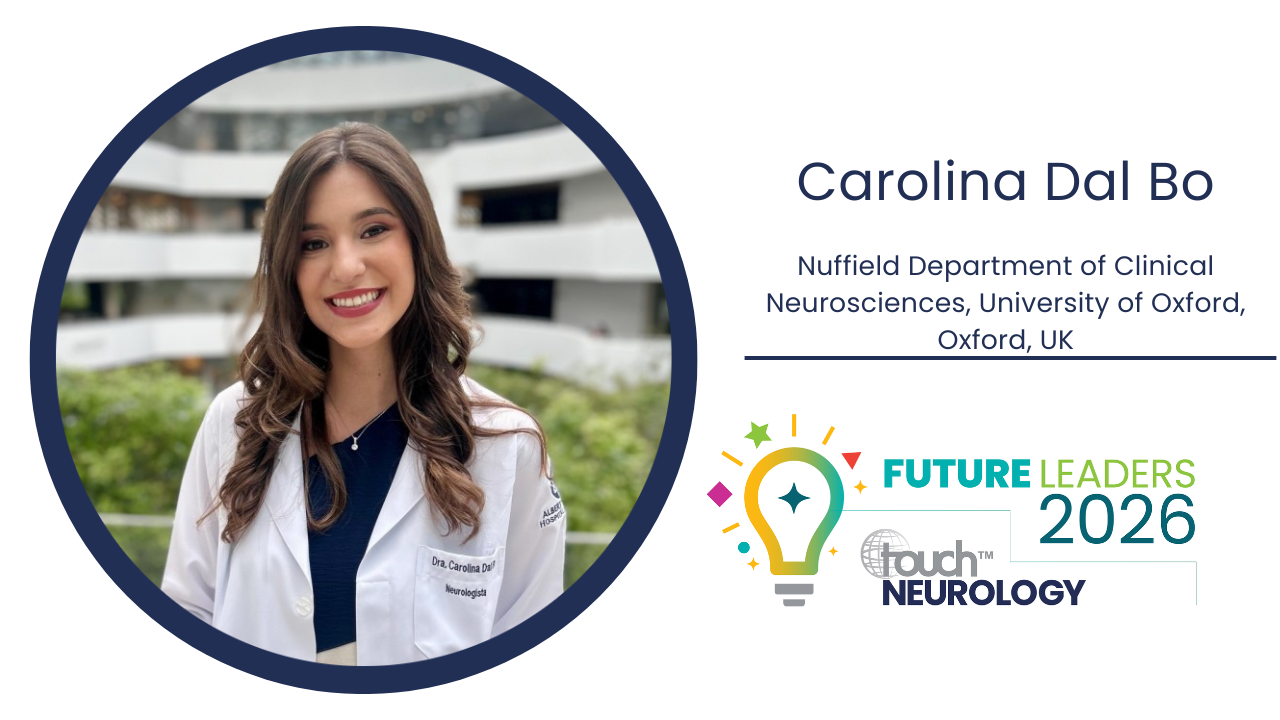
From falling in love with the neurological examination to researching rare neuroimmunological disorders, Dr Carolina Dal Bo (Nuffield Department of Clinical Neurosciences, University of Oxford, Oxford, UK) reflects on the experiences that shaped her career and the advances transforming patient care in this interview with touchNEUROLOGY.
Dr Carolina Dal Bo is a neurologist and neuroimmunology fellow from Brazil, whose work focuses on rare inflammatory disorders of the central nervous system, including myelin oligodendrocyte glycoprotein antibody-associated disease (MOGAD) and neuromyelitis optica spectrum disorder (NMOSD) and Multiple Sclerosis (MS). Awarded a European Committee for Treatment and Research in Multiple Sclerosis (ECTRIMS) fellowship, Dr Dal Bo is investigating pregnancy outcomes and disease activity in women with these rare conditions, with the aim of improving evidence-based care and supporting informed family planning.
What inspired you to pursue a career in neurology?
I completed both medical school and my neurology training in Einstein Hospital Israelita in Brazil before moving to Oxford to undertake a neuroimmunology fellowship awarded by the European Committee for Treatment and Research in Multiple Sclerosis (ECTRIMS).
My interest in neurology began during medical school, during my first neurology rotation. I immediately fell in love with the neurological examination. I was fascinated by how an experienced neurologist could spend time performing a careful clinical examination and then accurately localize a lesion before any imaging had been performed.
I remember seeing clinicians confidently say, “I think this patient has a lesion in the left lateral medulla,” and then seeing the MRI confirm exactly that. It felt almost magical.
I realized that neurology is often like solving a puzzle. Reaching a diagnosis can be challenging and requires persistence, careful observation and detective work, but being able to provide patients with answers is incredibly rewarding.
I also value the long-term relationships that neurologists build with their patients. Many neurological conditions require ongoing care over many years, allowing you to support patients throughout different stages of their lives and help them navigate the challenges they face.
What has been the most rewarding moment in your journey so far?
Receiving the ECTRIMS Clinical Training Fellowship has been one of the most rewarding milestones of my career. It has given me the unique opportunity to deepen my knowledge of neuroimmunology at the University of Oxford and John Radcliffe Hospital under the mentorship of internationally recognized experts. It has also enabled me to contribute to research addressing important unanswered questions in rare neuroimmunological diseases.
My current research focuses on pregnancy in women with NMOSD and MOGAD. We are investigating how disease activity changes during pregnancy and how these conditions may affect pregnancy outcomes.
Because these diseases often affect young adults, questions about pregnancy and family planning are extremely common in the clinic. It has been incredibly rewarding to begin presenting our findings at scientific meetings and to see how the research can help answer questions that patients ask every day.
Research can sometimes feel like working with spreadsheets and statistical analyses, but moments like these remind me that the work ultimately helps improve patient care.
“Research can sometimes feel like working with spreadsheets and statistical analyses, but ultimately it is about answering questions that matter to patients.”
Which current innovations or developments in neurology excite you most for the future?
Neurology has changed enormously over the past decade. People often described neurology as a specialty where you could diagnose diseases but had relatively few treatment options. Colleagues from other specialties would often ask, “What can you actually do for your patients?”. That perception has changed dramatically, particularly in neuroimmunology. We now have numerous disease-modifying therapies that are making a real difference to patients’ lives.
One particularly exciting milestone came just a few months ago, when the first positive clinical trial of a treatment for MOGAD was presented. Until now, there have been no approved therapies specifically for this disease, so seeing these advances is incredibly encouraging.
The progress has been equally remarkable in multiple sclerosis (MS). Today, we have more than 20 approved therapies, and early diagnosis combined with timely treatment has dramatically improved long-term outcomes. Ten years ago, many patients accumulated significant disability over time. Now, with earlier diagnosis and appropriate treatment, many people can continue living active lives with far fewer disabilities.
Watching this transformation take place has been one of the most exciting aspects of working in neurology.
Have there been mentors who have influenced your journey?
I have been fortunate to learn from many remarkable mentors throughout my career, making it difficult to choose just one.
Professor Luis Otávio Caboclo, my Clinical Neurology professor in medical school, played an important role at a time when I was still deciding which specialty to pursue. He took the time to sit down with me over lunch, listened to my aspirations, and helped me think through that decision. His guidance gave me the confidence to choose neurology.
During my Neurology Specialty Training, Dr. Rafaela Almeida, a vascular neurologist, taught me that being a good neurologist is about much more than making the right diagnosis. She showed me the importance of listening carefully to patients, understanding what matters to them, and advocating for them throughout their journey. Her example continues to influence the way I care for my own patients.
I also had the opportunity to train with an exceptional neuroimmunology team in Brazil, including Dr. Rodrigo Thomaz and Dr. Lívia Dutra. They taught me the value of clinical curiosity and attention to detail. Rather than accepting uncertainty, they carefully examined every clue and consistently looked beyond the obvious until they reached the correct diagnosis. Their approach strengthened my clinical reasoning and taught me to remain curious, even in the most challenging cases.
I am now fortunate to be mentored by Professor Jacqueline Palace and Professor Maria Isabel Leite at the University of Oxford. Working with them has shown me how the most meaningful research begins with careful listening to patients and thoughtful clinical observation. They encourage me to question, think independently, and generously create opportunities for my academic and professional development. I know the lessons I am learning from them will stay with me throughout my career.
What advice would you give to someone starting a career in neurology?
Don’t wait until you feel completely ready. Early in your career, it is easy to question your abilities and hesitate to apply for opportunities because you think you may not be good enough. My advice is to apply anyway. You may be surprised by what you can achieve.
I would also encourage young neurologists and researchers to build networks, attend conferences and speak to people. Those conversations often lead to collaborations, new opportunities and lifelong mentorships that can shape your career.
More content in neuroimmunology
Cite: Dr Carolina Dal Bo on bridging clinical care and research in neuroimmunology: touchNEUROLOGY Future Leader 2026. touchNEUROLOGY. 30 June 2026.
Editor: Katey Gabrysch, Editorial Director.
Disclosures: Carolina Dal Bo has nothing to disclose.
The content was developed and edited by human editors. No fees or funding were associated with its publication. touchNEUROLOGY utilize AI as an editorial tool (ChatGPT (GPT-4o) [Large language model]. https://chat.openai.com/chat).
This content has been developed independently by Touch Medical Media for touchNEUROLOGY in collaboration with Carolina Dal Bo. Views expressed are the speaker’s own and do not necessarily reflect the views of Touch Medical Media.
SIGN UP to touchNEUROLOGY!
Join our global community today for access to thousands of peer-reviewed articles, expert insights, and learn-on-the-go education across 150+ specialties, plus concise email updates and newsletters so you never miss out.