Open Nav
Open Nav

Check your Inbox
We've sent your certificate

Thank you
for your Feedback!
Activity Overview
Faculty & Disclosures
Activity Overview
Faculty & Disclosures

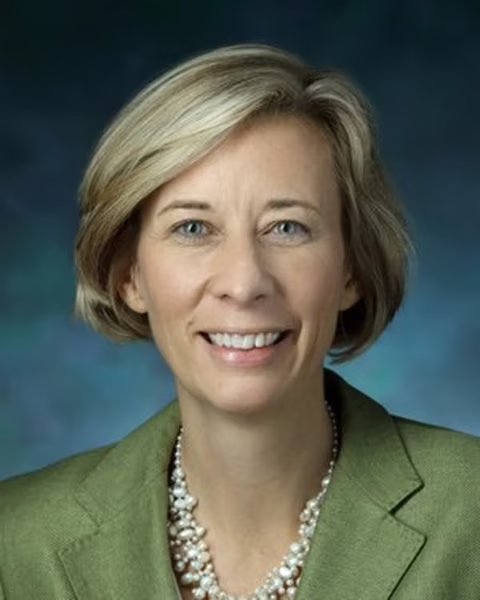
Charlotte J Sumner, MD
Johns Hopkins University School of Medicine, Baltimore, MD, USA
Biography
Charlotte Sumner is a neurologist at Johns Hopkins University who specializes in genetically mediated neuromuscular diseases. She co-directs the Muscular Dystrophy Association Care Center and leads research on motor neuron and peripheral nerve disorders, and has also authored more than 200 peer-reviewed articles.
Disclosures
Received grant funding from Actio Biosciences, Biogen, and Roche; has provided consultancy services for Biogen, Roche/Genentech, and Novartis; has acted in an unpaid advisory role for Actio Biosciences, Charcot-Marie-Tooth Research Foundation, CMT Association, Cure SMA, Epirium, Kennedy’s Disease Association, Merkin Peripheral Neuropathy Center, Muscular Dystrophy Association, Nura Bio, Packard Center for ALS Research, SMA Europe, and the SMA Foundation.
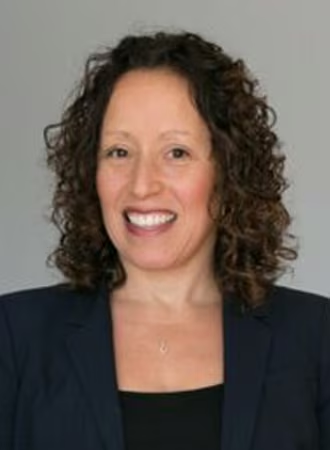
Jacqueline Montes, PT, EdD
Columbia University Irving Medical Center, New York, NY, USA
Jacqueline Montes, PT, EdD
Columbia University Irving Medical Center, New York, NY, USA
Biography
Jacqueline Montes is a professor of Rehabilitation and Regenerative Medicine at Columbia University Irving Medical Center, specializing in physical therapy for neuromuscular diseases. Her research focuses on gait, fatigue, and clinical outcomes in SMA and amyotrophic lateral sclerosis. She has played a key role in developing global standards of care for SMA physical therapy and has authored numerous peer-reviewed publications.
Disclosures
Received research or grant support from Biogen, Cure SMA, Genentech, Scholar Rock, Muscular Dystrophy Association and National Institute of Child Health and Human Development; has received honoraria (non-CME events) from Genentech and Scholar Rock; has acted as a consultant or participated in advisory boards for Argenx, Biogen, F. Hoffman-La Roche, NMD Pharma and Scholar Rock.
Charlotte J Sumner, MD
Johns Hopkins University School of Medicine, Baltimore, MD, USA

touchMEETING HIGHLIGHTS
This content is intended for healthcare professionals in the USA only.
Please confirm that you are a healthcare professional in the USA.


This activity has been sponsored by Biogen. Biogen provided financial support and video content, and has had input into the detailed project scope. This activity is provided by Touch Medical Communications (TMC) for touchNEUROLOGY.
Close Popup
Could not verify Country/IP Address.
We were unable to verify your IP address, please try again later. If you are using a method to hide your IP address, such as a VPN or proxy, please disable this and try again.
This activity is sponsored by Biogen.
Biogen provided financial support and video content, and has had input into the detailed project scope. This activity is provided by Touch Medical Communications (TMC) for touchNEUROLOGY.
Unapproved products or unapproved uses of approved products may be discussed; these situations may reflect the approval status in one or more jurisdictions. TMC has advised the sponsor to ensure that they disclose any such references made to unlabelled or unapproved use. No endorsement by TMC of any unapproved products or unapproved uses is either made or implied by mention of these products or uses in TMC activities. TMC accepts no responsibility for errors or omissions.
The views and opinions expressed are those of the faculty and do not necessarily reflect those of any sponsor.
Biogen-269294
Date of preparation: September 2025
Log into your Touch Account
Keep track of your clinical interests and newsletter subscriptions.
Sign up with an Email
Or use a .
Register now for FREE access
Already registered? Login below.