
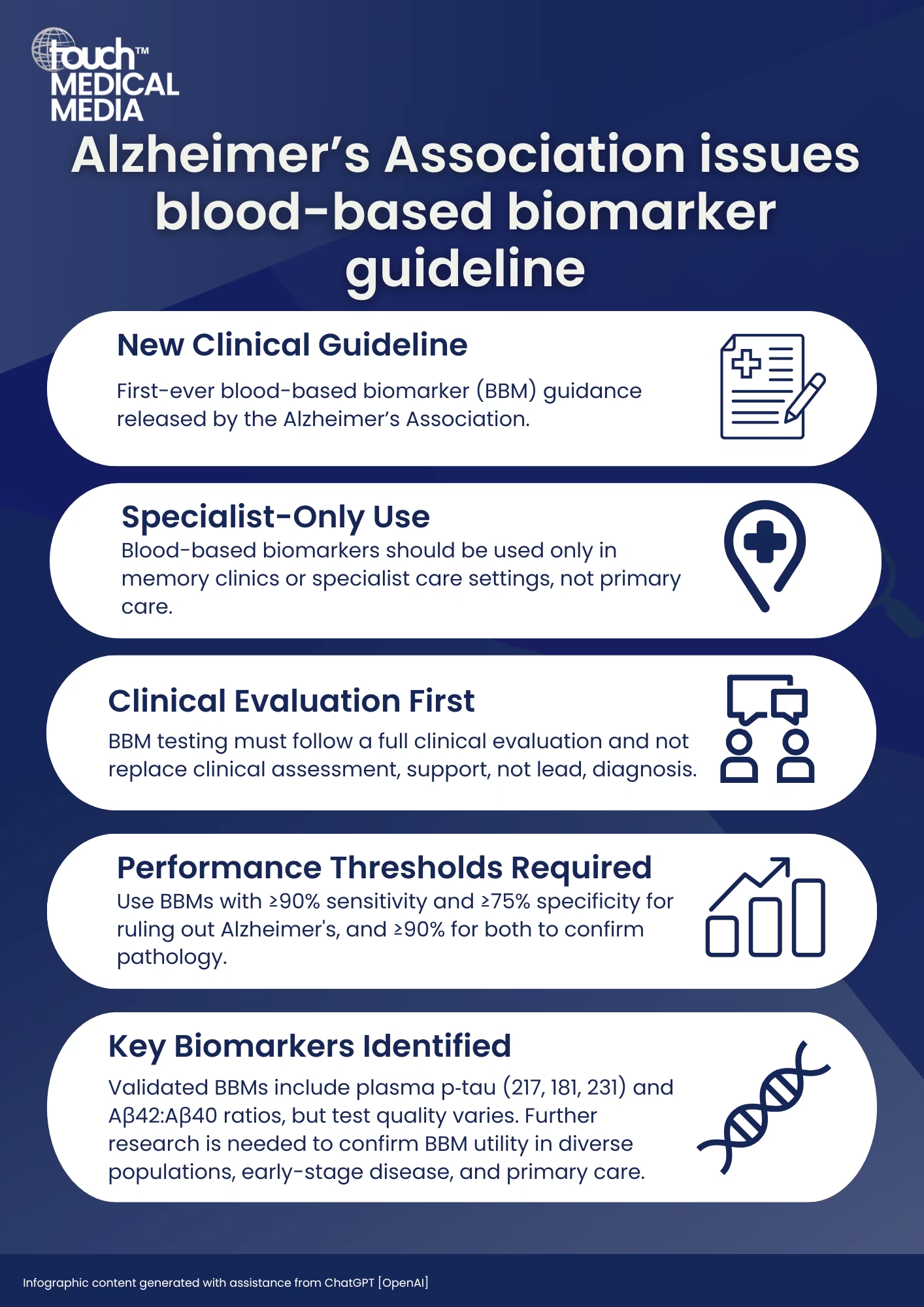
At AAIC 2025, the Alzheimer’s Association released its first-ever clinical practice guideline (CPG) for blood-based biomarker (BBM) testing in Alzheimer’s disease. This marks a significant step forward in the use of minimally invasive tests to support earlier and more accurate diagnosis in patients with cognitive impairment.
Access the Alzheimer’s Association Clinical Practice Guidelines here
Key guideline recommendations
The guideline offers performance-based, brand-agnostic recommendations focused on the clinical use of plasma biomarkers in specialist care settings:
- Triaging tool: Use a BBM with ≥90% sensitivity and ≥75% specificity o rule out Alzheimer’s disease pathology in patients presenting with objective cognitive impairment.¹
- Confirmatory tool: Use a BBM with ≥90% sensitivity and specificity in place of amyloid PET imaging or CSF biomarkers to confirm Alzheimer’s pathology.¹
- Clinical evaluation first: A strong good-practice statement reinforces that BBM testing should only follow a comprehensive clinical evaluation and never replace thorough diagnostic workups.¹
Which biomarkers are covered?
The CPG currently focuses on plasma p‑tau (p‑tau217, p‑tau181, p‑tau231), p‑tau217 to non‑p‑tau217 ratio, and Aβ42:Aβ40 ratio. These markers show the most evidence for clinical use.¹
However, the guideline notes that many commercially available BBMs do not yet meet the required thresholds for clinical decision-making.¹
Why this guideline matters
- More accessible diagnostics: Blood-based biomarkers can significantly improve access to Alzheimer’s diagnostics compared to PET imaging or lumbar punctures.
- Earlier diagnosis: Used appropriately, BBMs could help identify Alzheimer’s pathology earlier in the disease course.
- Clarity for clinicians: For the first time, neurologists and memory specialists have formal benchmarks to guide BBM interpretation and use in practice.¹
Limitations and future directions
- The guideline is based on 49 studies, including real-world data from over 31 different BBM tests. However, randomized controlled trial (RCT) evidence remains limited.¹
- Clinical utility in primary care and diverse populations has not yet been established.²
- Future guidelines are in development, including recommendations on cognitive assessments, Alzheimer’s staging, prevention strategies, and implementation planning.¹
“This is a pivotal moment in Alzheimer’s care,” said Maria C. Carrillo, Ph.D., Alzheimer’s Association chief science officer and medical affairs lead, and a co-author of the guideline. “For the first time, we have a rigorously evidence-based guideline that empowers clinicians to use blood biomarker tests confidently and consistently. Adoption of these recommendations will lead to quicker, more accessible, more accurate diagnoses — and better outcomes for individuals and families affected by Alzheimer’s.”
This new guideline provides a critical framework for the integration of blood-based biomarkers into Alzheimer’s diagnosis in clinical practice. It reflects growing consensus that BBMs are poised to transform care, but only when implemented with careful attention to performance thresholds, patient selection, and diagnostic context.
References
-
Alzheimer’s Association. Blood-Based Biomarkers for Alzheimer’s Disease: Clinical Practice Guideline. Presented at: Alzheimer’s Association International Conference® (AAIC) 2025; September 13–16, 2025; Philadelphia, PA. Available from: https://aaic.alz.org/releases-2025/clinical-practice-guideline-blood-based-biomarkers.asp (accessed 18 September 2025).
-
Palmqvist S, et al. Appropriate Use Criteria for Blood Biomarkers in Alzheimer’s Disease. Alzheimer’s & Dementia. 2024. PMID: 40729527.
Editor: Katey Gabrysch, Editorial Director.
Disclosures: This short article was prepared by touchNEUROLOGY. The content was developed and edited by human editors. No fees or funding were associated with its publication. touchNEUROLOGY utilize AI as an editorial tool (ChatGPT (GPT-4o) [Large language model]. https://chat.openai.com/chat).
Cite: First clinical practice guideline for blood-based biomarkers in Alzheimer’s diagnosis. touchNEUROLOGY. 18 September 2025.
Register now to receive the touchNEUROLOGY newsletter!
Don’t miss out on hearing about our latest peer reviewed articles, expert opinions, conference news, podcasts and more.