Open Nav
Open Nav

Check your Inbox
We've sent your certificate

Thank you
for your Feedback!
Activity Overview
Faculty & Disclosures
Activity Overview
Faculty & Disclosures
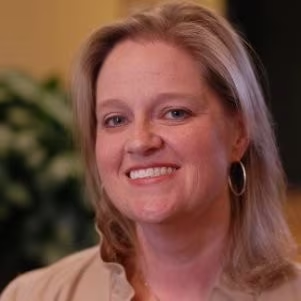
Annie Kennedy
EveryLife Foundation for Rare Diseases, Washington, DC, USA
Biography
Annie Kennedy is the Chief of Policy, Advocacy, and Patient Engagement at the EveryLife Foundation for Rare Diseases and has led major initiatives to improve rare disease care including the National Economic Burden of Rare Disease study, the Cost of Delayed Diagnosis project, and the development of the ICD Code Roadmap. Annie serves on numerous advisory boards and steering committees, including the NIH NCATS Advisory Council, the Cures Accelerator Network Advisory Board, and the Patient Driven Values in Healthcare Evaluation Steering Committee.
Disclosures
Nothing to Disclose.
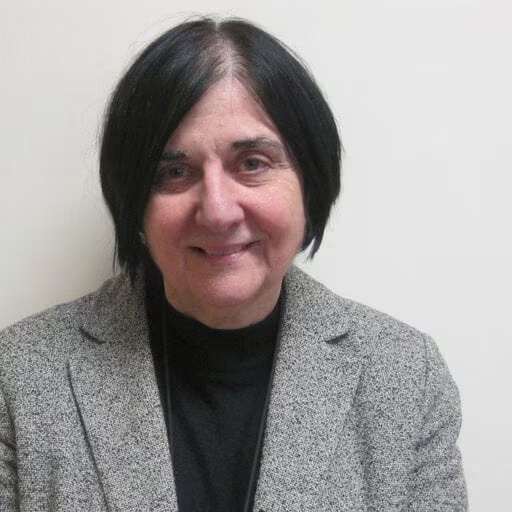
Terry Heiman-Patterson, MD
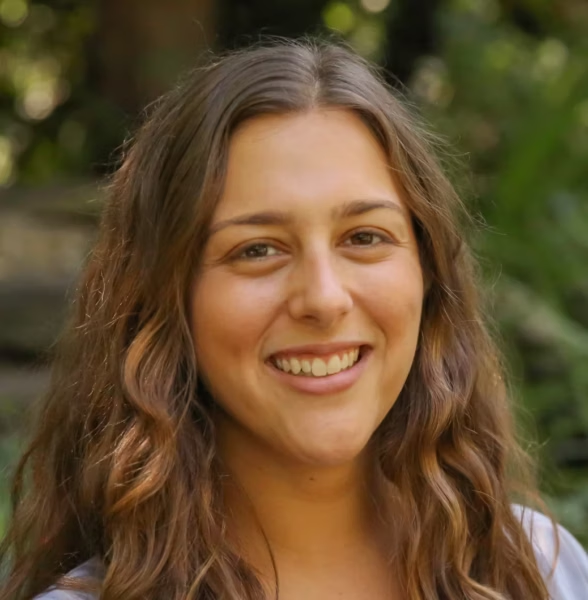
Laynie Dratch, ScM, CGC

Laynie Dratch, ScM, CGC
Penn Medicine Philadelphia, PA, USA
Biography
Laynie Dratch is a licensed, certified genetic counselor at the University of Pennsylvania Perelman School of Medicine. She received her ScM in genetic counseling from the Johns Hopkins University / National Institutes of Health training program. She specializes in the care and research of frontotemporal degeneration and ALS spectrum disorders.
Disclosures
Employee of Penn Medicine. Current or former consulting/advisory relationships with Sano Genetics, Passage Bio, and Biogen.
Annie Kennedy

Suma Babu, MBBS, MPH
Suma Babu, MBBS, MPH
Harvard Medical School, Boston, MA, USA
Biography
Suma Babu is an Associate Professor of Neurology at Harvard Medical School and co-director of the Neurological Clinical Research Institute at Massachusetts General Hospital. Her work specializes in the care and research of ALS and motor neuron diseases. She leads neuroimaging research programs focused on disease biomarkers and therapeutic development, and has served as a principal investigator for multiple Phase 1–3 ALS clinical trials.
Disclosures
Grants from NIH/NINDS; research funding from Ionis, Biogen, Novartis, OrphAI, and Denali; consulting fees to institution from uniQure and MarvelBiome; and honoraria from NIH and American Academy of Neurology
Laynie Dratch, ScM, CGC
Terry Heiman-Patterson, MD
Terry Heiman-Patterson, MD
Temple University, Philadelphia, PA, USA
Biography
Terry Heiman-Patterson is a Professor of Neurology at the Lewis Katz School of Medicine at Temple University and Director of the Temple MDA/ALS Center of Hope. In her work focusing on ALS and related motor neuron diseases, she has led multidisciplinary clinical programs and research focused on the mechanisms of motor neuron disease, therapeutic development, and patient-centered care. She has served as Co-Chair of the Northeast ALS Consortium Executive Committee and is a member of the ALS Research Group.
Disclosures
Funding from the Muscular Dystrophy Association, a clinical trial readiness grant from the ALS Association, Independent Investigator Funding from MTPA, medical advisory boards at MTPA, Amylyx, Cytokinetics, and Biogen, and clinical trial funding from Amylyx, Healey Trial, Cytokinetics, PKC, and MTPA.
Suma Babu, MBBS, MPH
Annie Kennedy

touchMEETING HIGHLIGHTS
This content is intended for healthcare professionals in the USA only.
Please confirm that you are a healthcare professional in the USA.

This activity has been sponsored by Biogen. Biogen provided financial support and video content, and has had input into the detailed project scope. This activity is provided by Touch Medical Communications (TMC) for touchNEUROLOGY.
Close Popup
Could not verify Country/IP Address.
We were unable to verify your IP address, please try again later. If you are using a method to hide your IP address, such as a VPN or proxy, please disable this and try again.
This activity is sponsored by Biogen.
Biogen provided financial support and video content, and has had input into the detailed project scope. This activity is provided by Touch Medical Communications (TMC) for touchNEUROLOGY.

Unapproved products or unapproved uses of approved products may be discussed; these situations may reflect the approval status in one or more jurisdictions. TMC has advised the sponsor to ensure that they disclose any such references made to unlabelled or unapproved use. No endorsement by TMC of any unapproved products or unapproved uses is either made or implied by mention of these products or uses in TMC activities. TMC accepts no responsibility for errors or omissions.
The views and opinions expressed are those of the faculty and do not necessarily reflect those of any sponsor.
Biogen-269580
Date of preparation: September 2025
Log into your Touch Account
Keep track of your clinical interests and newsletter subscriptions.
Sign up with an Email
Or use a .
Register now for FREE access
Already registered? Login below.