Trending Topic

Conceptual design with brain and red abstract background. Horizontal banner.
15 mins

Trending Topic

Developed by Touch
Mark CompleteCompleted
BookmarkBookmarked

Both intracerebral hemorrhage and ischemic stroke continue to be the leading causes of disability and the second leading causes of death worldwide.1,2 The burden is largest in low- and middle-income countries, which have seen rapid recent population growth. Large vessel occlusion (LVO – internal carotids, vertebrals and the proximal branches of the circle of Willis) accounts for 20% of all acute ischemic strokes (AISs) […]

touchFEATURE

DBS Programming in General Neurology: Expanding Access and Optimizing Patient Outcomes

Topics Covered:

Open Nav
By clicking the link below you will be leaving touchNEUROLOGY
touchNEUROLOGY

Check your Inbox

We've sent your certificate

Back to Activity
Close Popup
touchNEUROLOGY

Thank you
for your Feedback!

Back to Activity
Close Popup

Video Navigation

Videos

How General Neurologists Can Expand Access to DBS for Patients with Parkinson's disease and Essential Tremor

Peer-to-peer insights for general neurologists on how DBS, Image Guided Programming, and collaborative care models can expand patient access and reduce barriers to therapy.
Jessica Feldman, MD
Duration: 16:19

Chapter 1: DBS explained – what every general neurologist should know

In this video, meet Jessica Feldman, MD who introduces the video discussing foundational DBS education tailored to general neurology practice.
Start Time: 0:00

Chapter 2: Why many eligible patients do not receive DBS therapy and how general neurologists can help

Exploring access challenges and unmet needs in DBS therapy.
Start Time: 4:29

Chapter 3: How Image Guided DBS expands patient access in general neurology

How Image Guided Programming supports efficiency and confidence in DBS care.
Start Time: 6:07

Chapter 4: Reframing DBS - what physicians and patients should know.

Common misconceptions about patient candidacy and managing DBS post implant.
Start Time: 9:06

Chapter 5: Which patients with Parkinson’s disease and essential tremor are good candidates for DBS?

Insights on identifying appropriate DBS candidates.
Start Time: 10:55

Chapter 6: How DBS programming transformed my general neurology practice

Real-world impact of DBS on a general neurology practice.
Start Time: 14:44

A Neurosurgeon’s Perspective on Modern DBS and Patient Outcomes

Expert neurosurgical insights on DBS outcomes and innovation.
Casey Halpern, MD
Duration: 21:41

Chapter 1: DBS surgery overview for Parkinson’s disease and essential tremor

In this video, meet Casey Halpern, MD who introduces deep brain stimulation for Parkinson’s disease and essential tremor, and provides a neurosurgical overview of the procedure, clinical benefits, and recent innovations shaping DBS care today.
Start Time: 0:00

Chapter 2: DBS efficacy and patient impact in Parkinson’s disease and essential tremor

Understanding the clinical impact of DBS therapy for patients with Parkinson's disease and essential tremor.
Start Time: 5:20

Chapter 3: DBS surgical targets explained: STN, GPi, and VIM

Education on DBS targets and surgical planning.
Start Time: 7:28

Chapter 4: Innovations in DBS technology – improving surgical and programming outcomes

Highlighting key DBS technology innovations.
Start Time: 10:16

Chapter 5: How Illumina 3DTM Image Guided DBS Programming optimizes outcomes and expands access

How Image Guided Programming supports better DBS outcomes.
Start Time: 17:14

Chapter 6: How neurosurgeons and general neurologists can partner to expand DBS access

Neurosurgical perspectives on expanding DBS access through collaboration and Image Guided Programming.
Start Time: 18:32

Patient Testimonial Video

Patient Testimonial

This patient testimonial video features real-life experiences from a couple living with Parkinson’s disease. The video showcases deep brain stimulation (DBS) treatment delivered using Boston Scientific’s Illumina 3DTM technology, with stimulation settings tailored to the patient’s unique anatomy, and highlights the impact of DBS on Parkinson’s disease symptoms such as tremor and speech, as well as overall quality of life improvements.
Duration: 3:27

Activity Overview

Faculty & Disclosures

Downloads

Activity Overview
Faculty & Disclosures
Downloads

Deep brain stimulation (DBS) of the subthalamic nucleus (STN) and globus pallidus internus (GPi) for Parkinson’s disease, and the ventral intermediate nucleus (VIM) for essential tremor, has demonstrated robust and durable clinical efficacy in managing motor symptoms in patients with Parkinson’s disease and essential tremor that remain inadequately controlled with pharmacological therapy.1–3 

Recent technological innovations have fundamentally transformed DBS programming.4,6 Image Guided Programming (IGP) uses patient‑specific anatomical reconstructions from pre‑ and post‑operative imaging to support efficient DBS programming and improved clinical outcomes.4,5 Illumina 3D™, the latest advancement in IGP from Boston Scientific, generates a suggested stimulation field model (SFM) within seconds to provide an informed, anatomy‑based starting point clinicians can refine to individual patient needs.6

In this touchFEATURE, neurologist Jessica Feldman, MD, and neurosurgeon Casey Halpern, MD, discuss the clinical role of DBS in Parkinson’s disease and essential tremor, the need to broaden access to DBS within community neurology, and how advancements in DBS programming are facilitating collaboration across specialties to support patient care over time.

  • Outline the clinical efficacy of DBS and the benefits to patients with Parkinson’s disease or essential tremor
  • Understand the importance of expanding access to DBS in community neurology and the role of general neurologists in patient management
  • Highlight advances in DBS technology, including longer directional leads and Image Guided Programming, and their impact on programming efficiency and improving clinical outcomes
  • Explain how Illumina 3Dâ„¢, as the latest advancement in Image Guided Programming, applies an algorithm‑based approach to support efficient programming and interdisciplinary collaboration in DBS care
List View
Grid View
1

Jung IH, et al. Complications after deep brain stimulation: a 21-year experience in 426 patients. Front Aging Neurosci. 2022;14:819730.

2

Weaver FM, et al. Bilateral deep brain stimulation vs best medical therapy for patients with advanced Parkinson disease: a randomized controlled trial. JAMA. 2009;301(1):63–73.

3

Wharen RE Jr, et al. Thalamic deep brain stimulation with a constant-current device in essential tremor: a controlled clinical trial. Parkinsonism Relat Disord. 2017;40:18–26.

4

Lange F, et al. Reduced programming time and strong symptom control even in chronic course through imaging-based DBS programming. Front Neurol. 2021;12:785529.

5

Torres V, et al. Image-guided programming deep brain stimulation improves clinical outcomes in patients with Parkinson’s disease. NPJ Parkinsons Dis. 2024;10:29.

6

Aldred J, et al. Automated image guided programming algorithm supports clinicians during DBS programming for PD patients. Poster presented at the International Parkinson and Movement Disorders Society (MDS) annual meeting, Honolulu, HI, USA, October 5–9, 2025.

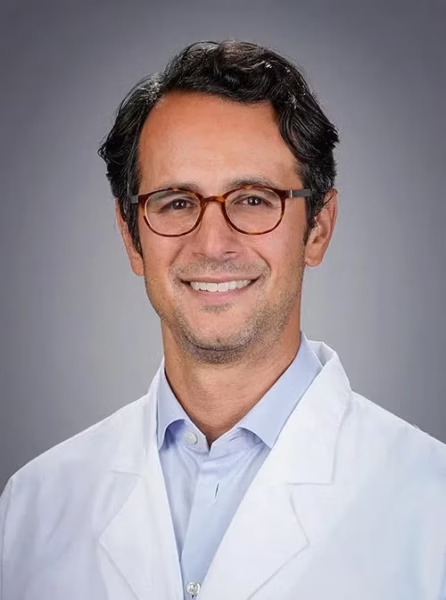
Jessica Feldman, MD

Penn Medicine and University of Pennsylvania Health System
Close Popup

Jessica Feldman, MD

Penn Medicine and University of Pennsylvania Health System
Philedelphia, PA, USA

Biography

Disclosures

Casey Halpern, MD

Perelman School of Medicine at the University of Pennsylvania and Penn Medicine

Casey Halpern, MD

Perelman School of Medicine at the University of Pennsylvania and Penn Medicine
Close Popup

Casey Halpern, MD

Perelman School of Medicine at the University of Pennsylvania and Penn Medicine

Neurosurgeon

Philedelphia, PA, USA

Biography

Disclosures

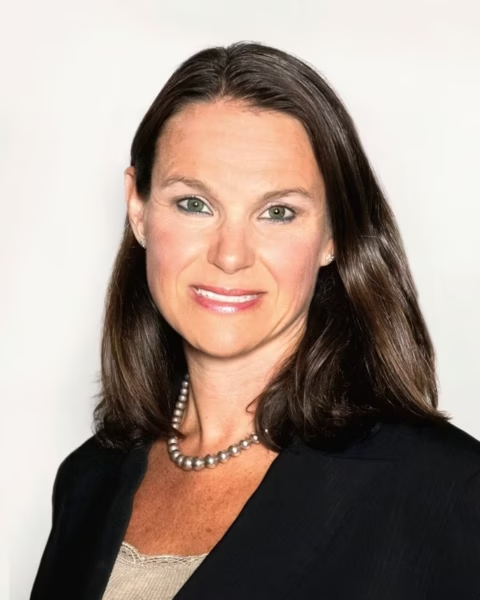
Jessica Feldman, MD

Penn Medicine and University of Pennsylvania Health System
Video Navigation

Videos

How General Neurologists Can Expand Access to DBS for Patients with Parkinson's disease and Essential Tremor

Peer-to-peer insights for general neurologists on how DBS, Image Guided Programming, and collaborative care models can expand patient access and reduce barriers to therapy.
Jessica Feldman, MD
Duration: 16:19

Chapter 1: DBS explained – what every general neurologist should know

In this video, meet Jessica Feldman, MD who introduces the video discussing foundational DBS education tailored to general neurology practice.
Start Time: 0:00

Chapter 2: Why many eligible patients do not receive DBS therapy and how general neurologists can help

Exploring access challenges and unmet needs in DBS therapy.
Start Time: 4:29

Chapter 3: How Image Guided DBS expands patient access in general neurology

How Image Guided Programming supports efficiency and confidence in DBS care.
Start Time: 6:07

Chapter 4: Reframing DBS - what physicians and patients should know.

Common misconceptions about patient candidacy and managing DBS post implant.
Start Time: 9:06

Chapter 5: Which patients with Parkinson’s disease and essential tremor are good candidates for DBS?

Insights on identifying appropriate DBS candidates.
Start Time: 10:55

Chapter 6: How DBS programming transformed my general neurology practice

Real-world impact of DBS on a general neurology practice.
Start Time: 14:44

A Neurosurgeon’s Perspective on Modern DBS and Patient Outcomes

Expert neurosurgical insights on DBS outcomes and innovation.
Casey Halpern, MD
Duration: 21:41

Chapter 1: DBS surgery overview for Parkinson’s disease and essential tremor

In this video, meet Casey Halpern, MD who introduces deep brain stimulation for Parkinson’s disease and essential tremor, and provides a neurosurgical overview of the procedure, clinical benefits, and recent innovations shaping DBS care today.
Start Time: 0:00

Chapter 2: DBS efficacy and patient impact in Parkinson’s disease and essential tremor

Understanding the clinical impact of DBS therapy for patients with Parkinson's disease and essential tremor.
Start Time: 5:20

Chapter 3: DBS surgical targets explained: STN, GPi, and VIM

Education on DBS targets and surgical planning.
Start Time: 7:28

Chapter 4: Innovations in DBS technology – improving surgical and programming outcomes

Highlighting key DBS technology innovations.
Start Time: 10:16

Chapter 5: How Illumina 3DTM Image Guided DBS Programming optimizes outcomes and expands access

How Image Guided Programming supports better DBS outcomes.
Start Time: 17:14

Chapter 6: How neurosurgeons and general neurologists can partner to expand DBS access

Neurosurgical perspectives on expanding DBS access through collaboration and Image Guided Programming.
Start Time: 18:32

Patient Testimonial Video

Patient Testimonial

This patient testimonial video features real-life experiences from a couple living with Parkinson’s disease. The video showcases deep brain stimulation (DBS) treatment delivered using Boston Scientific’s Illumina 3DTM technology, with stimulation settings tailored to the patient’s unique anatomy, and highlights the impact of DBS on Parkinson’s disease symptoms such as tremor and speech, as well as overall quality of life improvements.
Duration: 3:27

Add a Note

Note Time: 00:00
Save Note
touchNEUROLOGY
touchFEATURE

This content is intended for healthcare professionals in the US only.

Please confirm that you are a healthcare professional in the US.

Continue
Decline

This activity is sponsored by Boston Scientific.

Boston Scientific provided financial support and video content, and has had input into the detailed project scope. Video content is © 2026 Boston Scientific Corporation or its affiliates. All rights reserved. This activity is provided by touchMEDICAL for touchNEUROLOGY.

Close Popup
touchNEUROLOGY

Could not verify Country/IP Address.

We were unable to verify your IP address, please try again later. If you are using a method to hide your IP address, such as a VPN or proxy, please disable this and try again.

Boston Scientific provided financial support and video content, and has had input into the detailed project scope. This activity is provided by touchMEDICAL for touchNEUROLOGY.

Dr. Feldman and Dr. Halpern were compensated for their time in the creation of this activity.

All trademarks are the property of their respective owners

Close Popup