The Parkinson’s Companion is a free app developed with people living with Parkinson’s and international clinical experts. The app aims to bring a more structured, holistic approach to consultations, combining symptom awareness, medication-related considerations, and lifestyle support.
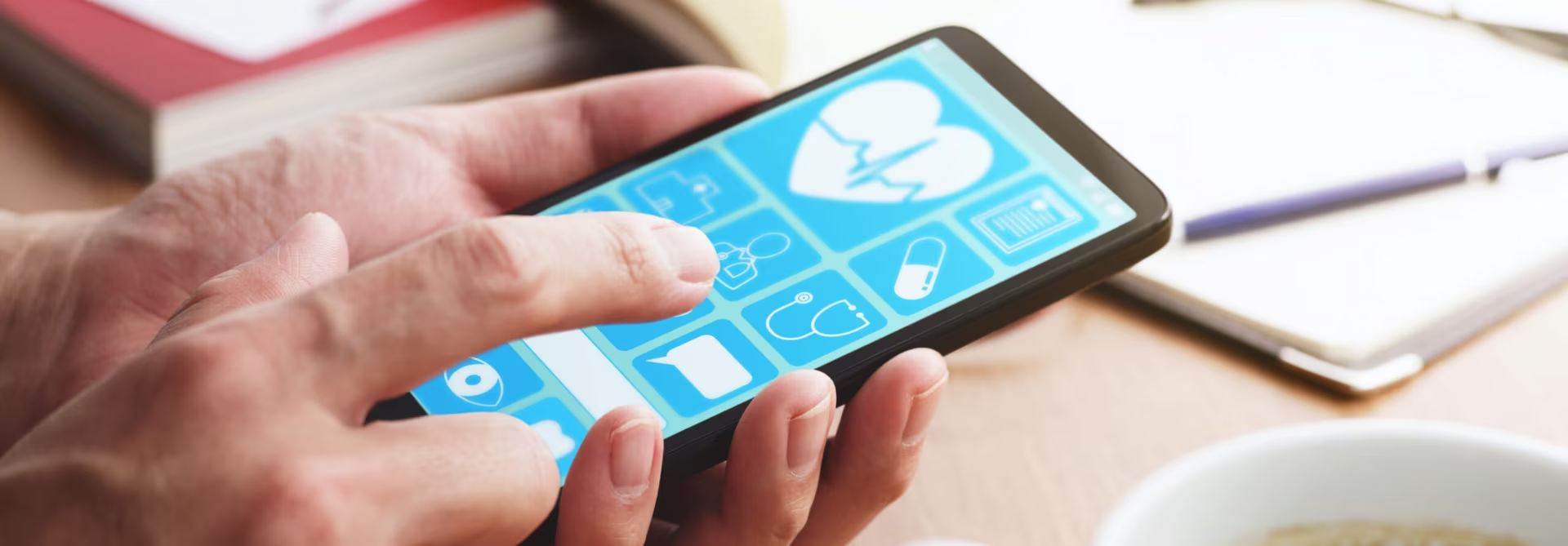
Parkinson’s disease is a complex condition extending well beyond its characteristic motor symptoms. Non-motor symptoms, comorbidities, medication-related issues, bone health, falls, and aspects of general health can all contribute substantially to an individual’s overall well-being, yet may be difficult to address comprehensively during a routine clinical consultation.1,2
The Parkinson’s Companion is a free educational and wellness app designed to help address this challenge by supporting both people living with Parkinson’s and the healthcare professionals involved in their care.3 Developed under the clinical leadership of Prof. K Ray Chaudhuri, alongside an expert patient group led by Sir Nicholas Mostyn and an international group of Parkinson’s specialists, the app translates a holistic clinical framework into a practical digital resource.
touchNEUROLOGY spoke with Prof. K Ray Chaudhuri, alongside Sir Nicholas Mostyn to discuss how the app translates a holistic clinical framework into a practical digital resource.
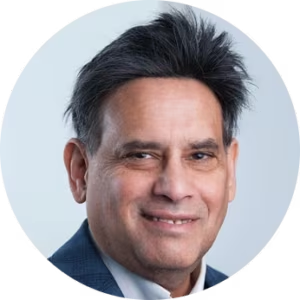 Prof. K Ray Chaudhuri is a leading neurologist and internationally recognised expert in Parkinson’s disease and movement disorders. He is Professor of Movement Disorders and Neurology at King’s College London and has led extensive research into the non-motor symptoms of Parkinson’s and patient-centred models of care. Professor Chaudhuri played a central role in the development of the Parkinson’s Companion app, working with Sir Nicholas Mostyn, people living with Parkinson’s and an international group of experts to create practical tools that support more personalised management of the condition.
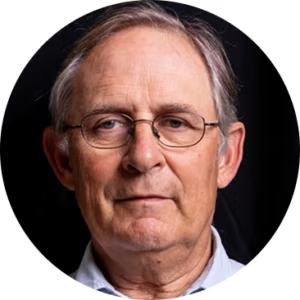 Sir Nicholas Mostyn is a retired High Court judge, Parkinson’s advocate and co-founder of the award-winning Movers and Shakers podcast. Diagnosed with Parkinson’s in 2020, he has become a prominent voice for people living with the condition. Drawing on his own experience, Sir Nicholas worked closely with Professor K Ray Chaudhuri and an Expert Patient Group to help shape the Parkinson’s Companion app and the Chaudhuri–Mostyn Dashboard, ensuring that the tools reflect the priorities and practical needs of people with Parkinson’s.
From unmet needs to a digital companion
The app is based on the Chaudhuri-Mostyn Dashboard, which builds on the concept of identifying key Parkinson’s ‘vitals’ that should be considered as part of comprehensive care.1,2 Rather than focusing predominantly on motor symptoms and dopaminergic treatment, the approach encourages consideration of a broader range of factors that can influence quality of life and clinical outcomes.
Prof. K Ray Chaudhuri: “We performed a global survey of questions posed in wide ranging clinics in over 10 countries and in almost all clinics, issues related to the vitals ranging from key nonmotor symptoms, to bone, vision, gut health or drug interaction, and the way levodopa is taken, was discussed in less than 15% of consultation. The publication of the Chaudhuri-Mostyn dashboard and the subsequent development of the Parkinson’s Companion app is based on this glaring unmet need.”
The importance of this more comprehensive approach has also been explored internationally. A 20-country survey of the wider Stepped Care framework, which incorporates the Parkinson’s dashboard, included people with Parkinson’s from diverse ethnic backgrounds and healthcare settings.4 In the survey, 99% of patients and caregivers reported that the toolkit addressed relevant needs and concerns that could otherwise be missed during Parkinson’s care, while 92% of clinicians considered it a potentially effective tool for clinical practice.4,5
Patient involvement has been central to the development of both the framework and the subsequent app, with input from expert patient groups alongside clinicians. This collaboration was intended to show that the resulting tool reflects the priorities of people living with Parkinson’s as well as those of healthcare professionals.
Bringing the five Parkinson’s vitals into consultations

The first section of The Parkinson’s Companion is structured around five core areas described within the Chaudhuri-Mostyn Dashboard:1–3
- motor symptoms
- non-motor symptoms
- vision, gut, and oral health
- bone health and falls
- comedications and comorbidities
For people living with Parkinson’s, the dashboard can act as a prompt when preparing for clinical appointments, helping identify symptoms or concerns that they may wish to discuss. For healthcare professionals, it provides an aide-memoire intended to support more comprehensive and consistent consultations.
This may be particularly relevant for symptoms that are not immediately visible or that patients may not automatically associate with Parkinson’s. The aim is not to replace clinical assessment, but to provide a simple framework through which a wider range of health issues can be considered.
Prof. K Ray Chaudhuri: “The app is free. It is designed to act as a practical prompt and a toolkit for busy practitioners and doctors to ensure that they have not forgotten the basic lifestyle based (e.g. safe exercises, sleep, water intake, probiotic) and levodopa pharmacokinetics based (e.g. levodopa and dairy interaction, Vitamin C intake) advices that are crucial for the motor and nonmotor health of the patient. These are the vitals described in the Chaudhuri-Mostyn dashboard for comprehensive care of Parkinson’s.”
Extending Parkinson’s management beyond medication
The second component of the app focuses on wellness and lifestyle. Parkinson’s UK describes this section as including accessible exercise and wellness resources, including short exercise videos that can be followed at home.3
This broader focus is increasingly reflected in discussions around contemporary Parkinson’s management. In 2026, an International Parkinson and Movement Disorder Society Task Force on Wellness proposed a multidimensional, patient-centered approach to wellness in Parkinson’s, incorporating lifestyle behaviors alongside motor and non-motor symptom management, mental health, general health, and multidisciplinary care.5,6 The review highlighted the Chaudhuri-Mostyn Dashboard as a means of prompting discussion of areas such as vision, gut, oral and bone health, and comedications and comorbidities.5,6
Prof. K Ray Chaudhuri: “The Parkinson’s Companion aims to give users practical information that extends beyond medication management, while encouraging more informed discussions with their clinical team.
Modern management of Parkinson’s goes well beyond the traditional levodopa and dopamine replacement therapy based pharmacotherapy. It requires:
- integration of lifestyle based advices on sleep and water intake as well as safe exercises;
- encouragement of the use of probiotics to enrich the gut microbiota;
- seeking to ensure a dairy free passage of levodopa absorption;
- Looking out for potentially damaging medication intake in certain subtypes of Parkinson (anticholinergics in the cholinergic subtype).
All of these steps need to be provided in a composite package and not piecemeal. The app seeks to assist healthcare professionals to ensure all this is done and to empower patients to ask for them.”
Supporting patient empowerment and global access
Accessibility has been another priority in the app’s development. The Parkinson’s Companion is free to download and is currently included within the Parkinson’s UK Tech Guide, which describes it as a resource aimed at helping people with Parkinson’s and healthcare professionals feel better informed and prepared when managing the condition.3
The international involvement in the underlying framework may also be important. The 20-country survey evaluating the Stepped Care approach included both higher-resource and under-resourced clinical settings and a multi-ethnic population, supporting the principle that structured prompts for holistic care may have relevance across different healthcare systems.5,6
According to the development team, further engagement with the International Parkinson and Movement Disorder Society is also planned.
Prof. K Ray Chaudhuri: “We would want this app to be used by all patients when possible by health care professionals across the world. The downloads of this app reflects the usefulness to patients and doctors and we would encourage endorsement of the app by patient care charities and learned societies. We are also in the process of developing a more user friendly version 2 of the app.”
Digital tools cannot replace individualized clinical care, but they may provide an additional way of helping people with Parkinson’s identify what matters to them and communicate those priorities effectively. By placing patient experience alongside clinical expertise and broadening attention beyond motor symptoms, The Parkinson’s Companion represents one approach to translating the principles of holistic Parkinson’s care into everyday practice.
Sir Nicholas Mostyn: Sir Nicholas observes that for him a primary driver for developing the app was to provide a means to seek to level the power imbalance between HCPs and PWPs in consultations.
He also passionately believes that the importance of exercise is emphasized at every turn. It is the only thing that actually slows the progression of this nasty disease.
Acknowledgments: Prof. K Ray Chaudhuri and Sir Nicholas Mostyn thank Kings College Hospital Charity (Reta Robinson, Iona Joy) for supporting the development of this app as well as R Kataria Foundation for ongoing support as well as all international advisors and expert patients.
References
- Chaudhuri KR, Titova N, Qamar MA, et al. The dashboard vitals of Parkinson’s: Not to be missed yet an unmet need. J Pers Med. 2022;12:1994. DOI: doi.org/10.3390/jpm12121994.
- Qamar MA, Rota S, Batzu L, et al. Chaudhuri’s Dashboard of Vitals in Parkinson’s syndrome: An unmet need underpinned by real life clinical tests. Front Neurol. 2023;14:1174698. DOI: 10.3389/fneur.2023.1174698
- Parkinson’s UK. The Parkinson’s Companion. 2026. Available at: https://techguide.parkinsons.org.uk/catalogue/the-parkinsons-companion (accessed Septemeber 08, 2026).
- Poplawska-Domaszewicz K, Rodriguez-Blazquez C, Boura I, et al. An international 20 country patient and physician survey of the usability and acceptability of Stepped Care pathway in Parkinson’s disease. Sci Rep. 2025;15:39774. DOI: doi.org/10.1038/s41598-025-23465-2
- Poplawska-Domaszewicz K, Falup-Pecurariu C, Chaudhuri RK. An Overview of a Stepped-care Approach to Modern Holistic and Subtype-driven Care for Parkinson’s Disease in the Clinic. touchREVIEWS in Neurology. 2024;20(1):27-32. DOI: doi.org/10.17925/USN.2024.20.1.6
- Subramanian I, Ricciardi L, Schrag A, et al. A holistic wellness prescription for Parkinson’s disease: Evidence-based perspectives and unmet needs. Mov Disord Clin Pract. 2026;13:631–46.
More content in Parkinson’s disease
Cite: KR Chaudhuri, N Mostyn. The Parkinson’s Companion: Supporting holistic Parkinson’s care. touchNEUROLOGY. 10 September 2026.
Editor: Katey Gabrysch, Editorial Director.
Acknowledgments: Speakers thank Kings College Hospital Charity (Reta Robinson, Iona Joy) for supporting the development of this app as well as R Kataria Foundation for ongoing support as well as all international advisors and expert patients.
Disclosures: Prof. K Ray Chaudhuri discloses he is a consultant for Abbvie, Stada, Bial , Orion, and Merz; has received Grant/research support from Dubai Health Authority, Kataria Foundation; is on the advisory board for Dubai Health Authority and Kataria Foundation; and speaker’s bureau participant for Dubai Health Authority and Kataria Foundation.
Sir Nicholas Mostyn has nothing to disclose in relation to this article.
The content was developed and edited by human editors. No fees or funding were associated with its publication. touchNEUROLOGY utilize AI as an editorial tool (ChatGPT (GPT-4o) [Large language model]. https://chat.openai.com/chat).
This content has been developed independently by Touch Medical Media for touchNEUROLOGY in collaboration with Prof. K Ray Chaudhuri and Sir Nicholas Mostyn. Views expressed are the speaker’s own and do not necessarily reflect the views of Touch Medical Media.
SIGN UP to touchNEUROLOGY!
Join our global community today for access to thousands of peer-reviewed articles, expert insights, and learn-on-the-go education across 150+ specialties, plus concise email updates and newsletters so you never miss out.