 Insights from Piet Eelen on the pressures facing specialist nurses, gaps in person-centered care, and priorities for more sustainable multiple sclerosis services
Specialist multiple sclerosis (MS) nurses play an important role in treatment monitoring, symptom management, patient education, and coordination of care. However, increasing workloads and limited support can leave insufficient time for other essential aspects of care. A multinational survey conducted by MS Nurse PROfessional (MS Nurse PRO), an initiative of the European Multiple Sclerosis Platform (EMSP), gathered responses from 108 nurses in 15 European countries and identified significant pressures on nursing services.1,2
touchNEUROLOGY spoke with Piet Eelen, RN, MSc, Clinical Nurse Specialist at the National Multiple Sclerosis Center Melsbroek, Belgium, and Chair of the MS Nurse PRO Scientific Committee, in collaboration with EMSP, about the findings, their implications for people living with MS, and the changes needed to strengthen specialist nursing across Europe.

Piet Eelen
Piet Eelen, RN, MSc, is a Clinical Nurse Specialist in multiple sclerosis at the National Multiple Sclerosis Center Melsbroek, Belgium. His clinical interests include rehabilitation nursing, disease-modifying therapies, continence management, and lifestyle in MS. He has chaired the Belgian Association of MS Nurses since 2012 and the MS Nurse PRO Scientific Committee of EMSP since 2020. In 2024, he joined the board of the Belgian Study Group of MS Neurologists. He also contributes to nurse education, research, and national and international professional collaborations.
What was the focus of the survey, and what did you hope to achieve?
We designed the survey to better understand the workload of nurses caring for people with MS across Europe: how they spend their working time, the responsibilities they undertake, and which important tasks they are unable to complete because of time or resource constraints.
Conducted in 2024, the survey explored caseloads, treatment and symptom management, patient education, administrative responsibilities, and access to multidisciplinary support. Importantly, we wanted to go beyond identifying the challenges. We also asked nurses which practical solutions could improve their working conditions and help them deliver more comprehensive care.1,2
Our ultimate objective was to translate these findings into evidence-based policy recommendations. We want specialist MS nurses to have the time, resources, training, and professional recognition they need to provide high-quality, coordinated, person-centered care.
What do the findings reveal about the pressures facing MS nursing services, and how might these affect care?
One of the most striking findings was the scale of the workload. The survey identified an estimated mean caseload of 516 people with MS per full-time-equivalent nurse, exceeding the benchmark of 358 referenced in our research. Nearly three-quarters of respondents (74%) reported caring for more than 300 people with MS annually. In addition, 43% said they had no administrative support, meaning that valuable nursing time is spent on paperwork rather than direct patient care.1,2
We also found that important activities, including psychological support, advice on social benefits, and consultation with other members of the care team, may be left unfinished because of time constraints. This points to a fundamental challenge: healthcare systems are not always organized to make the best use of specialist nursing expertise.
For people living with MS, these pressures could contribute to fragmented care, difficulties accessing appropriate support, and insufficient attention to the wider impact of MS on everyday life. The survey did not directly assess patient outcomes, but it highlights why workload management is about more than nurses’ working conditions. It is also about protecting the quality, accessibility, and continuity of care.
What aspects of patient support are most at risk when specialist nurses lack sufficient time and resources?
When workloads become excessive, nurses understandably prioritize essential clinical responsibilities, such as monitoring disease-modifying therapies, managing symptoms and adverse effects, and educating patients. These activities are vital, but they can leave too little time to address psychological, social, and practical needs.
MS affects much more than physical health. It can influence employment, relationships, emotional well-being, independence, and participation in everyday life. Specialist MS nurses are often well placed to identify these needs, provide continuity, and connect people with psychologists, physiotherapists, occupational therapists, social workers, and other members of the multidisciplinary team. The importance of this broader, coordinated role is also recognized in European nursing consensus recommendations.3
Without sufficient time and resources, opportunities to identify emerging problems and provide timely support may be missed. Although our survey did not measure the effects on individual patients, it reinforces the need to assess nursing services in terms of more than appointments and treatment delivery.
High-quality MS care requires time for the whole person, not just the disease. It also means strengthening health literacy so that people with MS can take an active role in managing their condition and making informed healthcare decisions.
Which changes should policymakers and healthcare systems prioritize to make MS services more sustainable?
We believe three priorities must be addressed together.
- Improve workflows and reduce administrative burden. Nurses need more time for direct patient care. This requires streamlined processes, interoperable digital tools, stronger digital skills, appropriate administrative support, and affordable access to continuing and advanced professional education.
- Formally recognize specialist and advanced practice nursing roles. Increasing nurse numbers is essential, but healthcare systems must also make better use of existing expertise. We need clearer career pathways and appropriately defined referral, prescribing, and clinical decision-making responsibilities, supported by the necessary qualifications, governance, and safeguards.
- Embed multidisciplinary care in health policy. Specialist MS nurses should have a clearly defined, central role in coordinating care. Services should be organized so that nurses and other healthcare professionals can work collaboratively and use their full competencies to meet patients’ needs.
These priorities are reflected in MS Nurse PRO’s policy recommendations, which call for stronger professional recognition, improved access to multidisciplinary care, and practical measures to reduce avoidable administrative workload.4
European and national pilot programs could help demonstrate how these approaches affect care quality, efficiency, and workforce resilience. Ultimately, sustainable MS services require not only a stronger nursing workforce, but also better organization of care and more effective use of existing healthcare resources.
Related event
On December 1, 2026, MS Nurse PRO will convene a roundtable at the European Parliament in Brussels, hosted by Member of the European Parliament Billy Kelleher, to discuss advanced and specialist nursing as a response to Europe’s healthcare workforce challenges. The event will be accessible in person and via an English-language livestream; advance registration is required. You can register for the event here: Register.5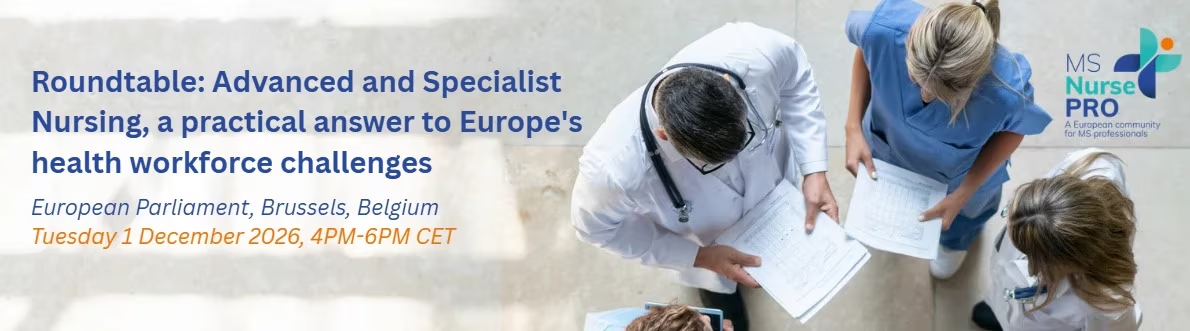
References
- Eelen P, De Corte S, Lopez Ramon N, et al. A multinational survey on the workload of nurses caring for people with multiple sclerosis in Europe. European Multiple Sclerosis Platform. Available at: www.msnursepro.org/advocacy (accessed November 3, 2026).
- Eelen P, De Corte S, Lopez Ramon N, et al. A multinational survey on the workload of nurses caring for people with multiple sclerosis in Europe: final results. Mult Scler. 2025;31(3 Suppl):215. Poster P111. doi:10.1177/13524585251358344.
- Pastore F, Robles Sanchez MA, Harrison CM, et al. The clinical nurse practitioner’s essential role in early diagnosis and management of multiple sclerosis in Europe: a consensus report. Int J MS Care. 2024;26:208–13. doi:10.7224/1537-2073.2023-070.
- MS Nurse PROfessional. Caring without burning out: How smarter workload strategies for nurses can safeguard quality care in European healthcare systems. 2026. Available at: www.msnursepro.org/advocacy (accessed November 3, 2026).
- MS Nurse PROfessional. Roundtable: Advanced and specialist nursing, a practical answer to Europe’s health workforce challenges. 2026. Available at: www.msnursepro.org/blog/6155-roundtable-advanced-and-specialist-nursing-a-practical-answer-to-europes-health-workforce-challenges (accessed November 3, 2026).
Cite: Rethinking multiple sclerosis nursing: Addressing workload pressures across Europe. touchNEUROLOGY. 03 November 2026.
Editor: Katey Gabrysch, Editorial Director.
Disclosures: This content has been developed independently by Touch Medical Media for touchNEUROLOGY.
This article was created by the touchNEUROLOGY team utilizing AI as an editorial tool (ChatGPT [large language model], https://chat.openai.com/chat). The content was developed and edited by human editors. No funding was received for publication of this article.
SIGN UP to touchNEUROLOGY!
Join our global community today for access to thousands of peer-reviewed articles, expert insights, and learn-on-the-go education across 150+ specialties, plus concise email updates and newsletters so you never miss out.