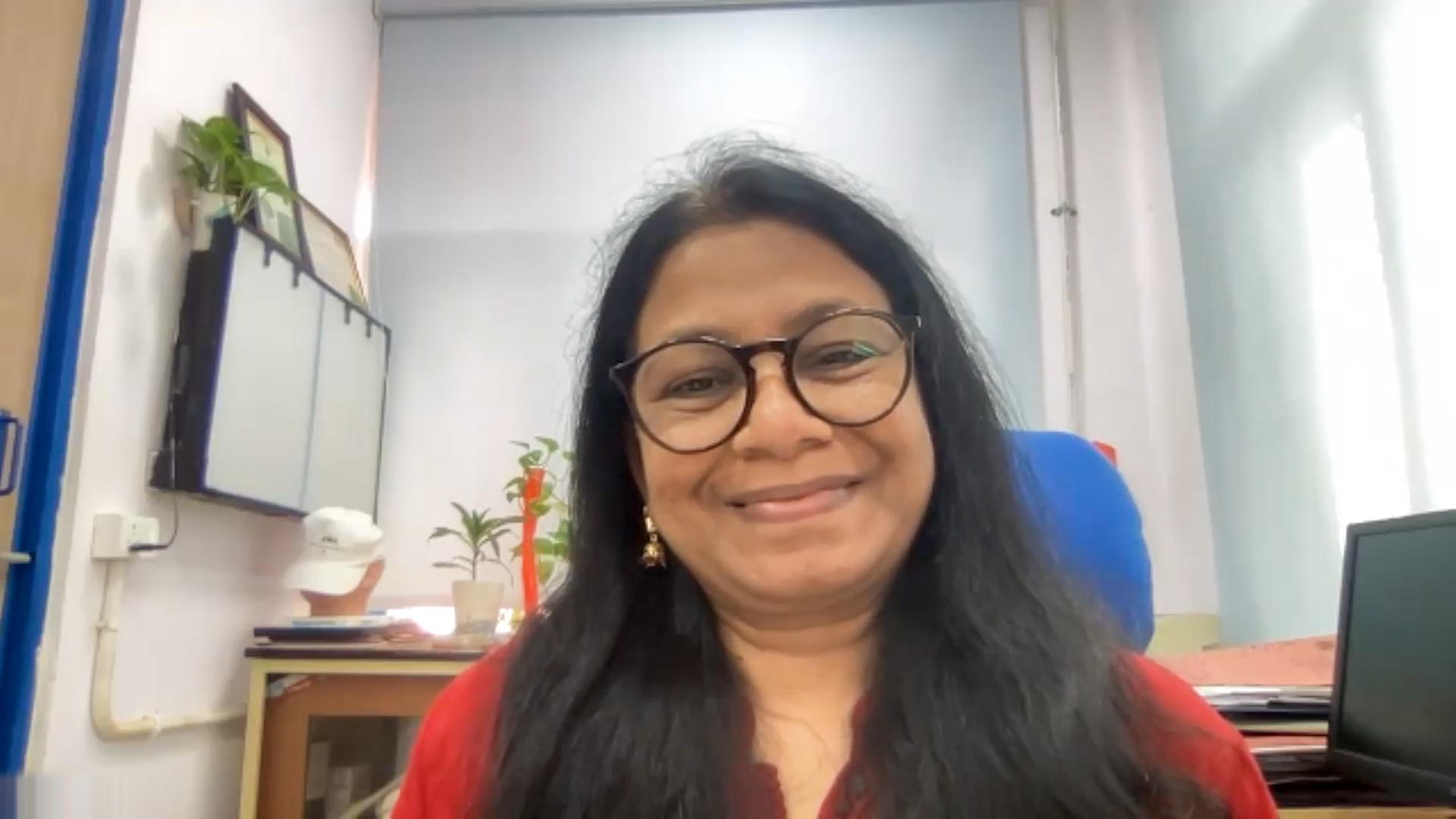
We are delighted to announce Dr Roopa Rajan as a touchNEUROLOGY Future Leader 2026, selected by peers as one of the neurologists changing the future of Parkinson’s disease and movement disorders.
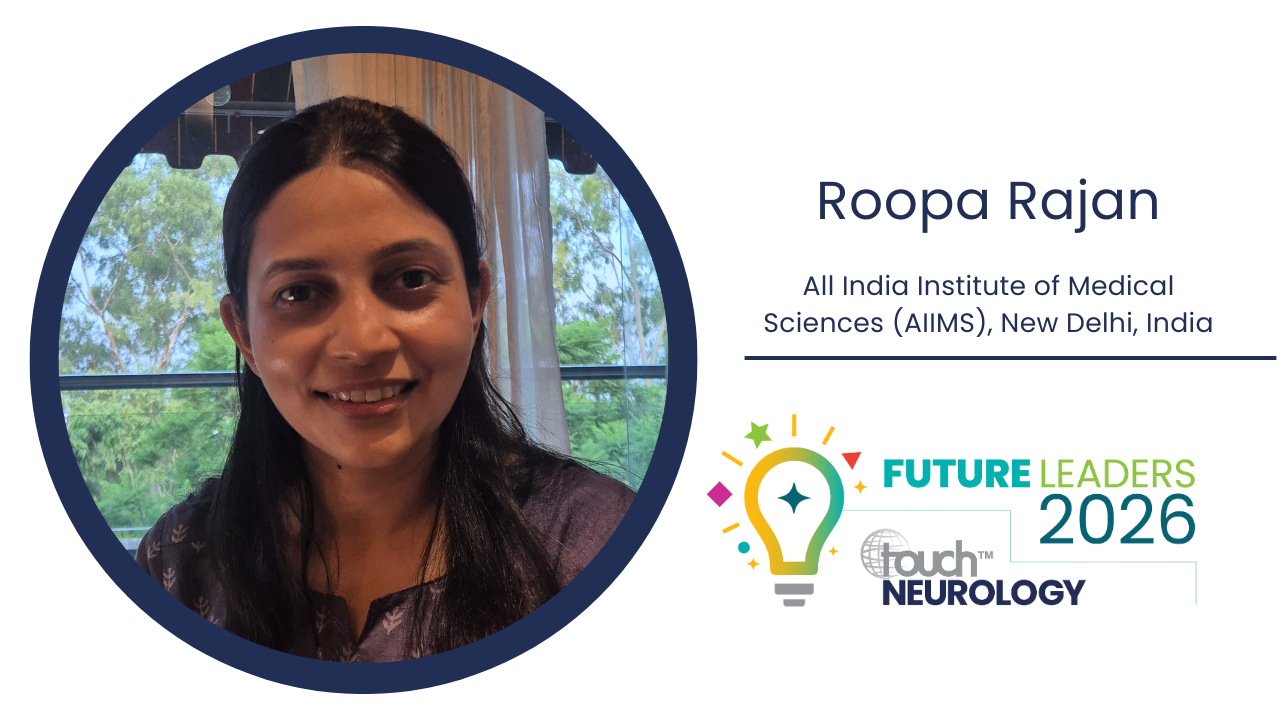
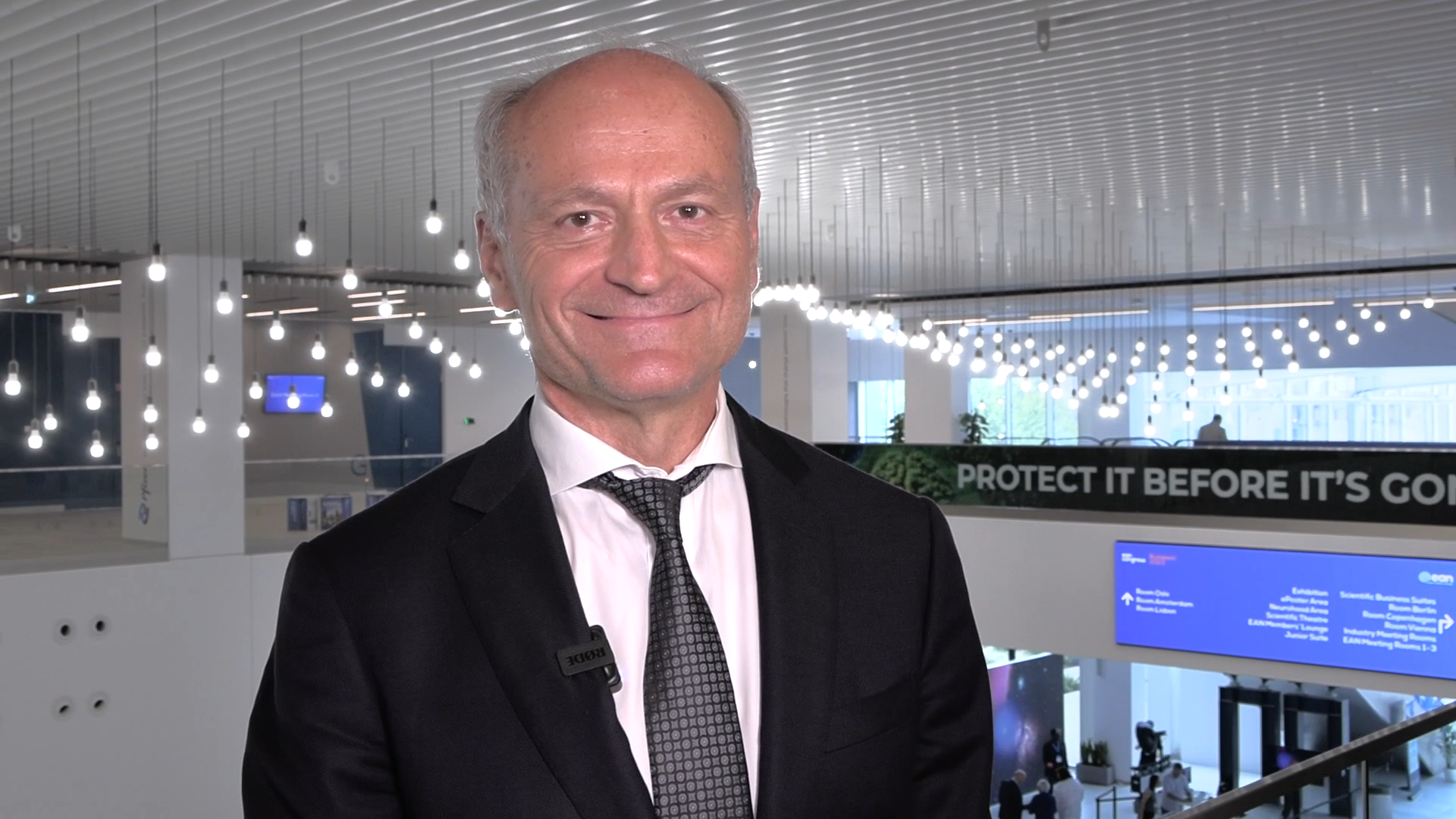
We spoke with Dr Roopa Rajan (All India Institute of Medical Sciences [AIIMS], New Delhi, India), an Additional Professor of Neurology and DBT/Wellcome Trust Clinical and Public Health Intermediate Career Fellow whose research focuses on the electrophysiology, genetics and treatment of movement disorders. Her work spans Parkinson’s disease, dystonia and tremor, combining deep brain stimulation, artificial intelligence and molecular research to develop more accurate diagnostics and personalized treatments for patients.
In this interview, Dr Rajan reflects on the experiences that inspired her career in neurology, discusses the milestones that have shaped her journey as a clinician-scientist, and explains why artificial intelligence, deep brain stimulation and transcriptomics could transform the future of movement disorders care.
What inspired you to pursue a career in neurology?
I am currently a movement disorders neurologist based in New Delhi, where I work at the All India Institute of Medical Sciences (AIIMS), the largest publicly funded tertiary healthcare institution in India.
I completed most of my medical training in India, but my interest in neurology really began while I was still at school. I was fascinated by the brain, particularly neurodevelopment and the way genetics, environmental influences and neuronal networks shape our decisions, behaviors and responses to the world around us. It struck me as an incredibly complex and fascinating system, and I realized early on that neuroscience was something I was passionate about.
During Grade 11, I had the opportunity to study in Singapore as an international scholar for my A-levels. That experience gave me my first real exposure to scientific research and strengthened my curiosity about neuroscience.
When I returned to medical school, I initially saw myself pursuing a research career. However, as I progressed through clinical medicine, I realized that every patient represents a research question in their own right. I became drawn to internal medicine and, ultimately, neurology because it still relies so heavily on clinical reasoning.
Unlike many other specialties, neurology requires you to carefully listen to the patient, formulate a diagnostic hypothesis, perform a detailed neurological examination and then use investigations to support your conclusions. It often feels like detective work, and I found that incredibly rewarding.
By the end of my neurology residency, I realized that movement disorders presented an even greater challenge. In conditions such as Parkinson’s disease, dystonia and tremor, imaging is often normal and diagnosis depends largely on clinical expertise. I enjoyed that challenge immensely.
Around the same time, movement disorders was becoming an exciting field, with advances such as deep brain stimulation and botulinum neurotoxin transforming patient care. It became a specialty where we could genuinely improve people’s quality of life, and that ultimately led me to complete a fellowship in movement disorders. Following my fellowship, I joined AIIMS, where I have now been working for almost 10 years.
What has been the most rewarding moment in your journey so far?
It is difficult to identify a single rewarding moment because there have been many throughout my career.
On a daily basis, the most rewarding aspect of my work is caring for patients. Whether through deep brain stimulation or optimizing medical management, being able to make a meaningful difference in someone’s quality of life is incredibly fulfilling.
From a research perspective, one of the most exciting areas has been our work using microelectrodes during deep brain stimulation surgery. These recording electrodes are normally discarded after surgery, but our laboratory has developed and validated a protocol to isolate RNA.
This allows us to study gene expression in living brain tissue from subcortical structures such as the subthalamic nucleus and globus pallidus. Most of what we currently know about Parkinson’s disease comes from blood samples, genetics or postmortem brain tissue. This approach provides a unique opportunity to study the transcriptome in living patients and follow them longitudinally to understand how gene expression relates to symptoms and treatment response.
Being able to validate this technique and see such promising results has been incredibly rewarding.
We have also established the Indian Movement Disorders Registry and Biobank, particularly for patients with dystonia and tremor. This has enabled us to identify important genetic variants within our population and generate insights that are already helping to inform clinical practice.
Has there been a mentor who has had a particularly important influence on your career?
Absolutely. I have been incredibly fortunate stand on the shoulders of giants during my career.
From medical school onwards, Professor Vasudevan, who headed our medical school, inspired my interest in research through his work in biochemistry.
During my residency, Professor Vivek Lal (PGIMER, Chandigarh, India) supervised both my internal medicine and neurology dissertations and played a major role in my academic development.
“I have been incredibly fortunate to stand on the shoulders of giants during my career.”
Most of what I know about movement disorders I learnt during my fellowship under Professor Asha Kishore. Working with her was a transformative experience. She has been an exceptional mentor and has supported me throughout every stage of my career.
I have also benefited enormously from the guidance of Professor Pramod Pal (NIMHANS, Bengaluru, India) and Professor Kameshwar Prasad (AIIMS, New Delhi, India), all of whom have helped shape my journey.
Which current innovations or developments in neurology excite you most for the future?
The transcriptomics research I mentioned is one area that excites me enormously because it gives us a unique opportunity to study living brain tissue in patients with Parkinson’s disease, dystonia and tremor.
Artificial intelligence (AI) is another area that I believe will transform neurology.
“Artificial intelligence could help bridge the gap between the growing demand for neurological care and the limited availability of specialist expertise.”
Particularly in India, AI has tremendous potential because we have a very large population of people living with Parkinson’s disease and other movement disorders, but relatively few neurologists. Our laboratory has developed an AI-based platform that analyzes hand-drawn spirals to objectively classify tremor and support Parkinson’s disease diagnosis, allowing tremor features to be assessed objectively rather than relying solely on clinical interpretation.
We are currently evaluating this tool in community studies and randomized clinical trials to determine whether it can improve Parkinson’s disease screening and help monitor tremor more effectively.
I believe technologies like these could help bridge the gap between the growing demand for neurological care and the limited availability of specialist expertise, particularly in resource-limited settings.
Deep brain stimulation is another rapidly evolving field. New technologies, including sensing electrodes and closed-loop stimulation, are already available, and I believe we will continue to see significant advances that further improve symptom management
Finally, I am excited by the progress being made in gene therapies for rare movement disorders and inherited neurological diseases. Several of these approaches are now entering clinical trials, and I am optimistic that they will offer entirely new treatment possibilities for our patients.
More content in movement disorders
Cite: Dr Roopa Rajan on advancing movement disorders research in India: touchNEUROLOGY Future Leader 2026. touchNEUROLOGY. 08 July 2026.
Editor: Katey Gabrysch, Editorial Director.
Disclosures: Roopa Rajan has nothing to disclose,
The content was developed and edited by human editors. No fees or funding were associated with its publication. touchNEUROLOGY utilize AI as an editorial tool (ChatGPT (GPT-4o) [Large language model]. https://chat.openai.com/chat).
This content has been developed independently by Touch Medical Media for touchNEUROLOGY in collaboration with Dr Roopa Rajan. Views expressed are the speaker’s own and do not necessarily reflect the views of Touch Medical Media.
SIGN UP to touchNEUROLOGY!
Join our global community today for access to thousands of peer-reviewed articles, expert insights, and learn-on-the-go education across 150+ specialties, plus concise email updates and newsletters so you never miss out.