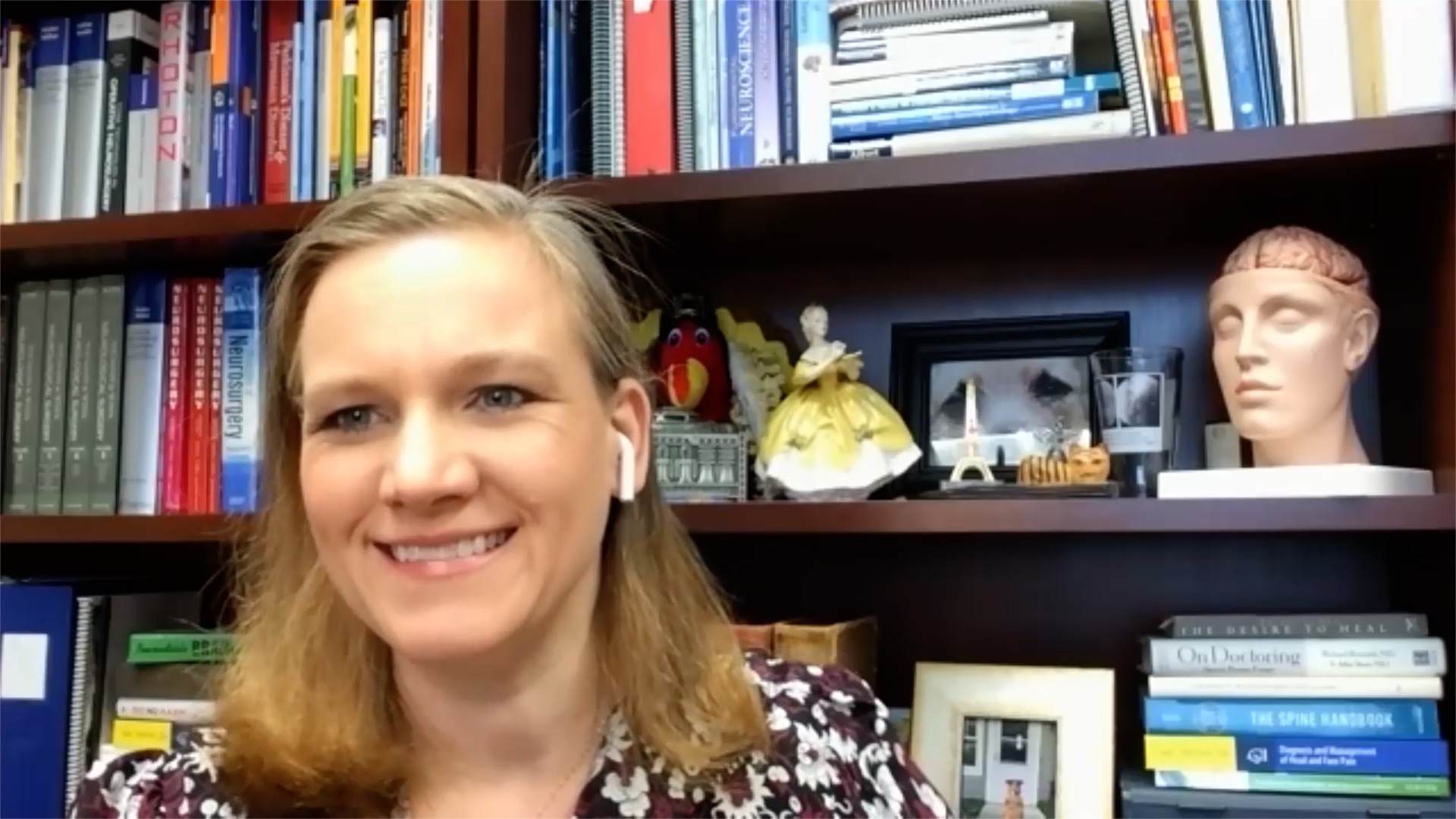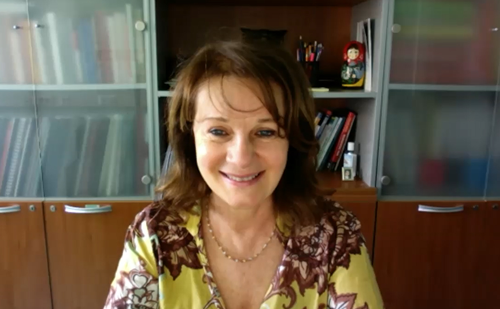
We are delighted to announce Dr Sarah Haigh as a touchNEUROLOGY Future Leader 2026, selected by peers as one of the neurologists changing the future of research in sensory symptoms in neurological disorders.
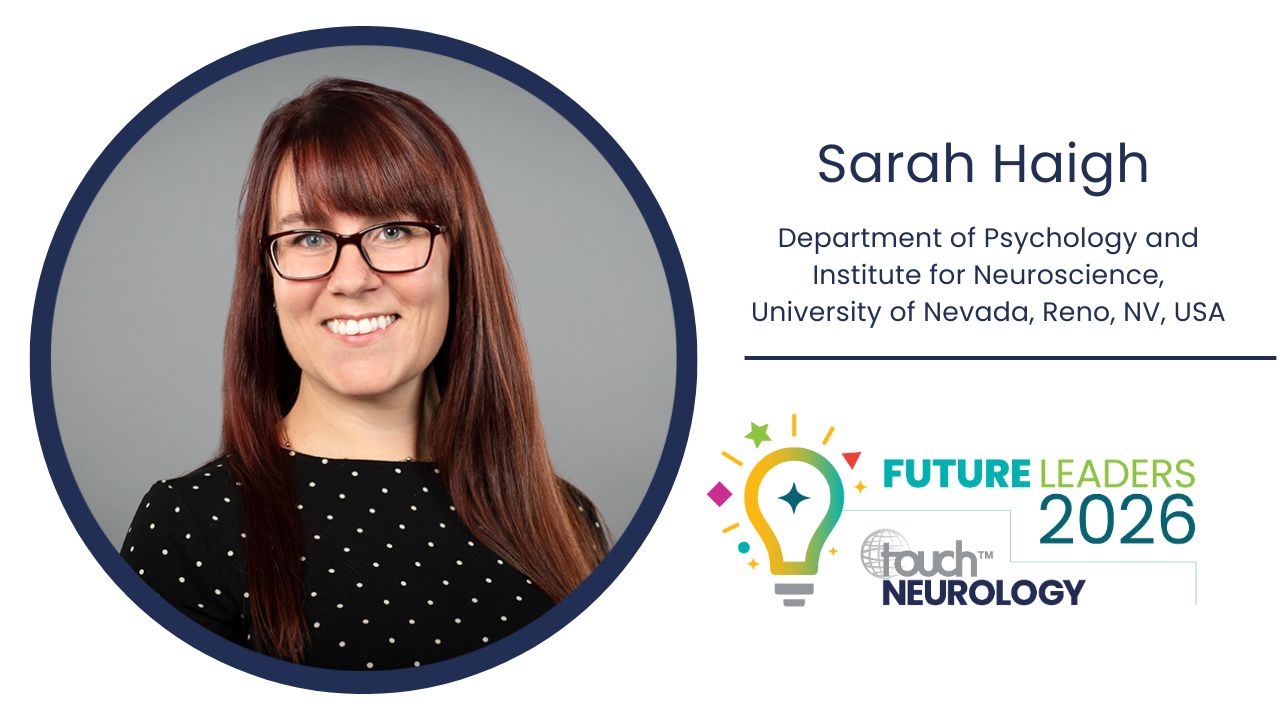
We spoke with Dr Sarah Haigh (Department of Psychology and Institute for Neuroscience, University of Nevada, Reno, NV, USA), an Associate Professor whose research focuses on sensory processing and sensory discomfort across neurological and neurodevelopmental conditions. Her work seeks to understand why individuals experience the same sensory environment so differently and how these differences provide insight into underlying brain function. Through research spanning perception, visual discomfort and neurodiversity, Dr Haigh is helping to improve recognition of often-overlooked sensory symptoms, uncover their neurobiological mechanisms and inform practical strategies that improve quality of life for people living with neurological conditions.
In this Future Leaders interview, Dr Haigh reflects on the curiosity that first drew her to neuroscience, discusses the growing recognition of sensory symptoms across neurology, and explains why greater scientific understanding is already leading to meaningful changes in how we design environments and support people with sensory differences.
“For far too long, people experiencing sensory symptoms were often dismissed, overlooked or left without answers.”
What inspired you to pursue a career in neurology?
I am a sensory neuroscientist and have always been fascinated by how physics and biology intertwine to create our conscious experience. My curiosity grew when I discovered that two people can perceive the same thing very differently. Take something as simple as a black-and-white striped pattern, one person might find it pleasant or stimulating, while someone else could experience discomfort, visual distortions, headaches or even seizures.
Realizing that individual differences in perception reflect differences in underlying brain function sparked my fascination with neuroscience.
“It is remarkable that something as seemingly simple as a striped pattern can provide such profound insights into how the brain works, and that idea continues to drive my research today.”
Another important source of inspiration has been my mentors. Beyond their guidance, I have been inspired by the stories they have shared about their careers, the people they have worked with and the patients they have met. I also remain inspired by the individuals seeking answers about their sensory symptoms, and by the researchers and clinicians dedicated to understanding and treating them.
What has been the most rewarding moment in your journey so far?
One of the most rewarding experiences has been seeing the field of visual discomfort come together over the past few years. An interdisciplinary group of researchers and clinicians now meets annually to discuss the key scientific and clinical questions in this area.
This collaboration represents a major step forward. Despite being a surprisingly common complaint, visual discomfort was once dismissed as little more than an aesthetic preference. Our discussions have focused on defining visual discomfort, understanding its underlying mechanisms, exploring its effects on the brain and identifying strategies to reduce or eliminate symptoms.
These meetings have been incredibly valuable, bringing the field together, identifying important gaps in our knowledge and highlighting the barriers that have slowed progress. We are already seeing the impact of this collaboration through the publication of a recent review paper, and our next meeting will be hosted by the Royal Society in London.
It is exciting to see years of work by a dedicated community leading to greater recognition of this often-overlooked group of sensory symptoms.
Which current innovations or developments in neurology excite you most for the future?
I am particularly excited by the growing recognition of sensory symptoms, including sensory discomfort, both in neurological conditions and across the wider neurodiverse population.
For far too long, people experiencing these symptoms were often dismissed, overlooked or left without answers, despite the significant impact these challenges can have on quality of life. Seeing these experiences formally recognized gives me hope that we can provide more effective support and a better understanding of the underlying mechanisms.
Importantly, this increased awareness is already leading to meaningful changes. We are seeing modifications to building facades, improved lighting and reading environments, sensory rooms, and dedicated quiet shopping hours for people who benefit from lower levels of sensory stimulation.
These changes demonstrate that greater scientific understanding can directly improve people’s everyday lives, and I hope this momentum continues.
More content in sensory disorders
Cite: Dr Sarah Haigh explores our understanding of sensory symptoms in neurological disorders: touchNEUROLOGY Future Leader 2026. touchNEUROLOGY. 24 March 2026.
Editor: Katey Gabrysch, Editorial Director.
Disclosures: Sarah Haigh has nothing to disclose.
The content was developed and edited by human editors. No fees or funding were associated with its publication. touchNEUROLOGY utilize AI as an editorial tool (ChatGPT (GPT-4o) [Large language model]. https://chat.openai.com/chat).
This content has been developed independently by Touch Medical Media for touchNEUROLOGY in collaboration with Sarah Haigh. Views expressed are the speaker’s own and do not necessarily reflect the views of Touch Medical Media.
SIGN UP to touchNEUROLOGY!
Join our global community today for access to thousands of peer-reviewed articles, expert insights, and learn-on-the-go education across 150+ specialties, plus concise email updates and newsletters so you never miss out.