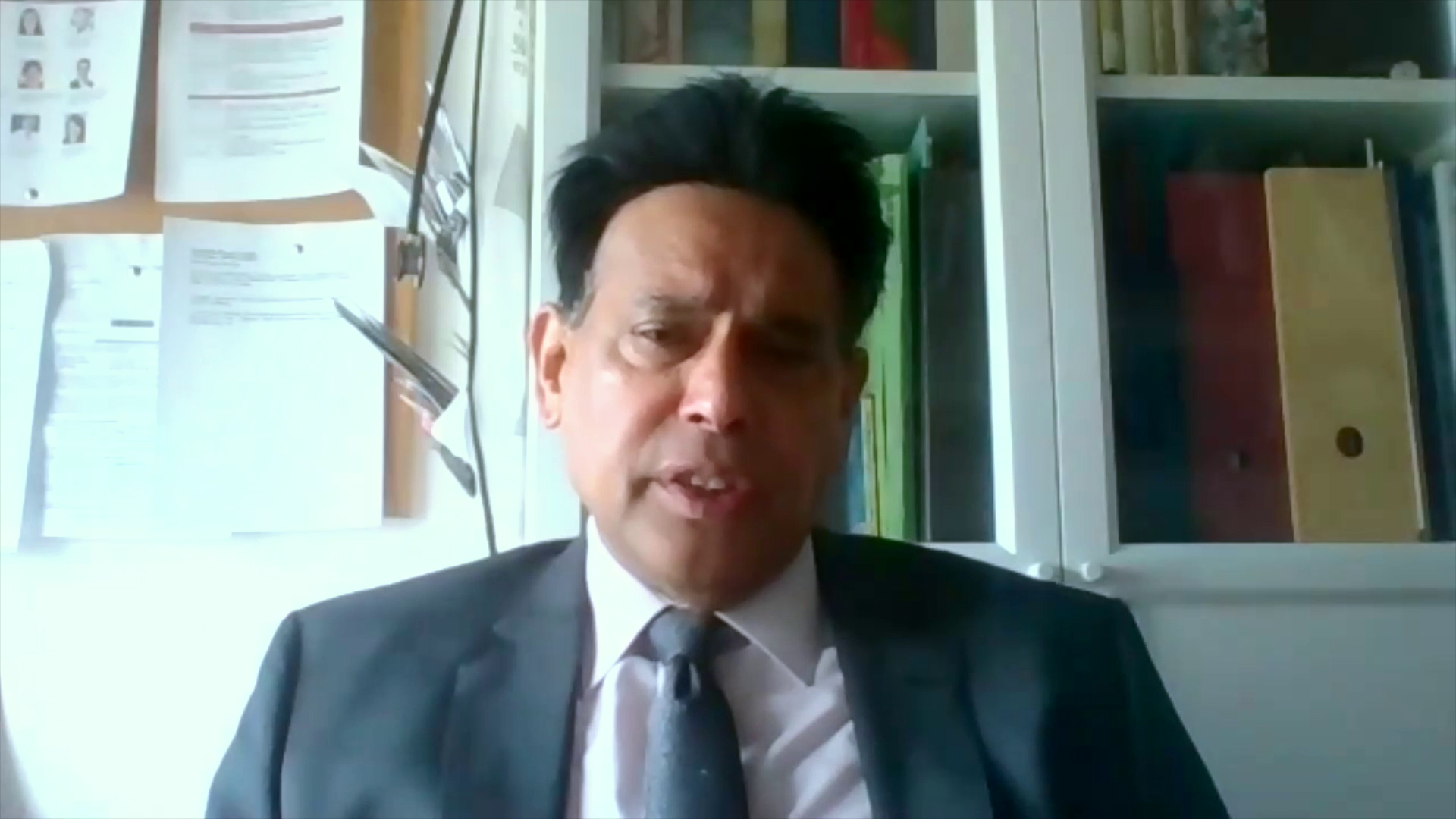
We are delighted to announce Dr Abidemi Otaiku as a touchNEUROLOGY Future Leader 2026, selected by peers as one of the neurologists changing the future of research in sleep, dreaming and brain health
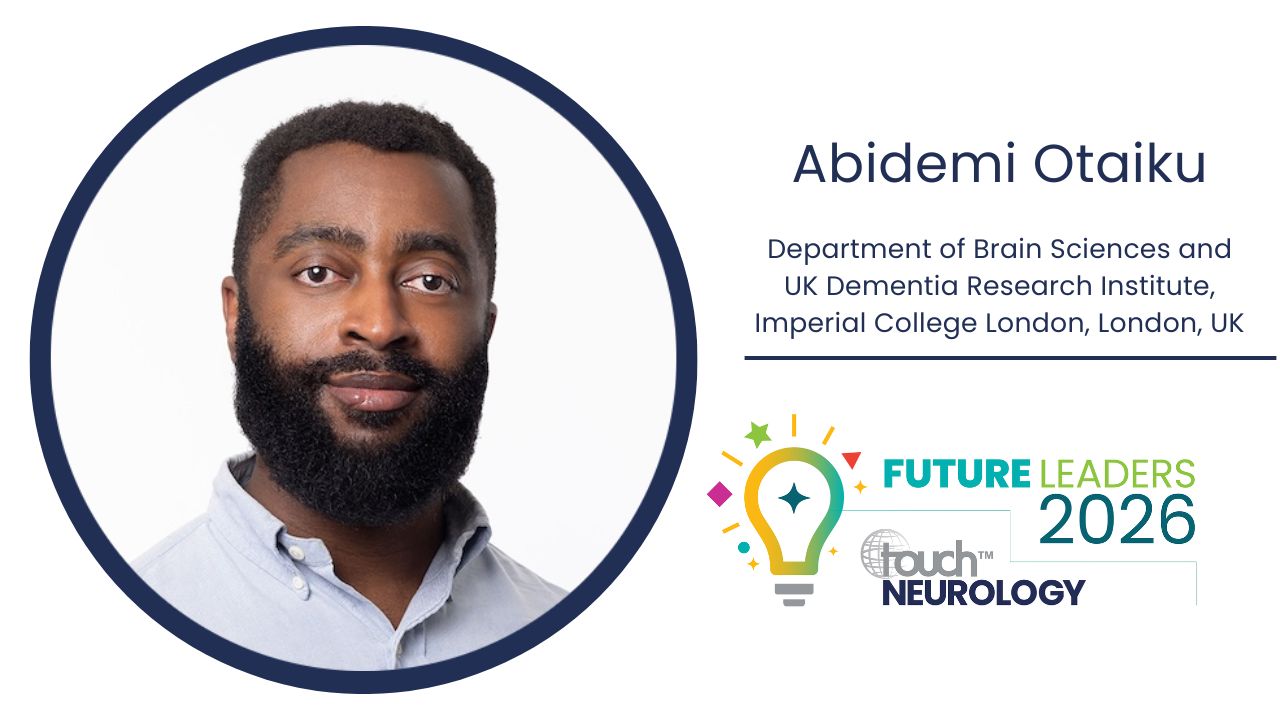 Dr Abidemi Otaiku (Department of Brain Sciences and UK Dementia Research Institute, Imperial College London, London, UK; Imperial College Healthcare NHS Trust, London, UK) is a Clinical Research Fellow and honorary specialty registrar in neurology whose research explores the neurobiological basis of sleep and dreaming. His work focuses on understanding how sleep and dreaming change during healthy aging and neurodegenerative diseases, and how these insights can be used to improve brain health, promote healthy longevity and identify early markers of neurological disease.
Alongside his research, Dr Otaiku is an NHS Clinical Entrepreneur and an award-winning science communicator. His work has been published in leading scientific journals and featured by international media outlets, including The Guardian, The Economist, BBC, CNN Portugal and Newsweek. His articles for The Conversation, exploring the relationship between sleep, dreaming and neurodegenerative diseases, have been read by more than two million people worldwide and have helped bring neuroscience research to a global audience.
In this interview, Dr Otaiku shares what inspired his career in neurology, reflects on the role of science communication in shaping his journey and discusses why sleep and dreaming may hold the key to earlier detection of neurodegenerative disease.
What inspired you to pursue a career in neurology?
Given that I entered medical school intending to become a plastic surgeon, neurology was quite an unexpected detour. However, several factors gradually drew me toward the specialty.
A major factor was my growing interest in philosophy. During medical school, I spent much of my spare time reading and reflecting on philosophical topics such as consciousness, free will and the mind–body problem. I wanted to find a way to integrate these interests with my medical career, and neurology seemed uniquely positioned to bridge the scientific and philosophical questions that captivated me.
At the same time, I became increasingly interested in the subspecialties of sleep medicine and cognitive neurology. I realized these subspecialties offered the opportunity to care for patients with disorders of the brain and mind while pursuing research in areas related to consciousness and cognition.
“Neurology could address some of the deepest and most profound questions about human nature.”
I was also inspired by neuroscientists and neurologists whose work I encountered through popular science articles and the media. Articles exploring the neuroscience of creativity, religious experience and consciousness showed me that neurology could address some of the deepest and most profound questions about human nature.
Finally, my early medical school lectures sparked a fascination with the workings of the brain itself. By my second year of medical school, it had become clear to me that academic neurology would be the ideal path to combine my clinical, scientific and philosophical interests, and I remain confident that this was the right choice for me.
What has been the most rewarding moment in your journey so far?
One of the most rewarding experiences of my career so far has been communicating my neurology research to the wider public.
One particularly rewarding experience was being invited to write three articles for The Conversation based on my research on nightmares as predictors of future dementia and Parkinson’s disease. I hoped the articles would resonate with readers, but I was both amazed and humbled to discover that they were read by more than two million people worldwide within a relatively short period. I have since received emails from students around the world telling me that they were inspired by my research.
“The possibility that my writing might spark curiosity in a young reader, or perhaps even inspire a future neurologist – is incredibly rewarding.”
What made this particularly meaningful was that science communication played an important role in my own decision to pursue a career in neurology.
Which current innovations or developments in neurology excite you most for the future?
I am particularly excited by the renewed interest in sleep across neurology.
Historically, sleep research was largely confined to sleep specialists, who represented a relatively small part of the neurology community. Today, however, the importance of sleep is increasingly recognized across multiple neurological subspecialties.
This is especially evident in cognitive neurology and movement disorders, where sleep disturbances are now understood to be early indicators of future neurodegenerative diseases, including dementia and Parkinson’s disease. Sleep is no longer viewed simply as a symptom; it is increasingly recognized as both a window into brain health and a potential therapeutic target.
One of the most fascinating developments is the growing interest in dreaming as a source of neurological information. From rapid eye movement (REM) sleep behavior disorder to nightmares, changes in dream experiences are emerging as very early, accessible markers of incipient neurodegenerative disease. Researchers are even beginning to investigate whether changes in dream recall itself may predict the development of neurological diseases.
I believe we have only scratched the surface of our understanding of the relationship between sleep, dreaming and brain health, and I am excited to continue contributing to the advancement of this field in the years to come.
More content in sleep disorders
Cite: Dr Abidemi Otaiku explores links between sleep, dreaming and brain health: touchNEUROLOGY Future Leader 2026. touchNEUROLOGY. 08 July 2026.
Editor: Katey Gabrysch, Editorial Director.
Disclosures: Abidemi Otaiku has nothing to disclose.
The content was developed and edited by human editors. No fees or funding were associated with its publication. touchNEUROLOGY utilize AI as an editorial tool (ChatGPT (GPT-4o) [Large language model]. https://chat.openai.com/chat).
This content has been developed independently by Touch Medical Media for touchNEUROLOGY in collaboration with Abidemi Otaiku. Views expressed are the speaker’s own and do not necessarily reflect the views of Touch Medical Media.
SIGN UP to touchNEUROLOGY!
Join our global community today for access to thousands of peer-reviewed articles, expert insights, and learn-on-the-go education across 150+ specialties, plus concise email updates and newsletters so you never miss out.