Leading experts share their perspectives on the most important therapeutic and treatment updates at AAN 2026 and discuss how these findings may shape the future of neurologic care
At American Academy of Neurology (AAN) Annual Meeting, Chicago, IL, USA, April 18–22, 2026, major advances across neuroimmunology, epilepsy, movement disorders and neuroinfectious disease highlighted the rapidly evolving therapeutic landscape in neurology. From positive phase 3 data in myelin oligodendrocyte glycoprotein antibody-associated disease (MOGAD) and emerging cell-based therapies in Parkinson’s disease, to next-generation antiseizure medicines and growing interest in personalized immune-based approaches, this year’s meeting showcased a wide range of potentially practice-changing developments.
In a series of interviews with touchNEUROLOGY, leading experts shared their perspectives on the most important therapeutic and treatment updates presented at the meeting and discussed how these findings may shape the future of neurologic care.
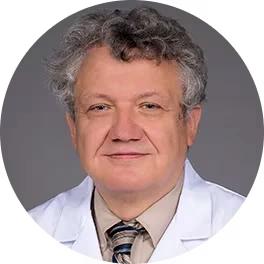 Prof. Peter Hedera
University of Louisville, Louisville, KY, USA
“There were many important updates this year. In movement disorders and neurodegeneration, one particularly interesting development was tavapadon for Parkinson’s disease. This selective D1 agonist appears to offer robust motor benefit with potentially improved tolerability compared with traditional dopamine agonists, including lower risks of impulse control disorders and hallucinations.
There was also major interest in cell-based therapies for advanced Parkinson disease. Large ongoing clinical trials are evaluating whether transplanted cells can provide both symptomatic benefit and potential neuroprotective effects, which could significantly change the treatment paradigm.
Outside movement disorders, there were also important developments in neuroimmunology, particularly Fc receptor-targeted therapies for conditions such as Myasthenia gravis and Chronic inflammatory demyelinating polyneuropathy.”
Read Dr Hedera’s full Q&A here: Tiomolibdate choline in neurologic Wilson disease: Insights from the phase 3 FoCus trial
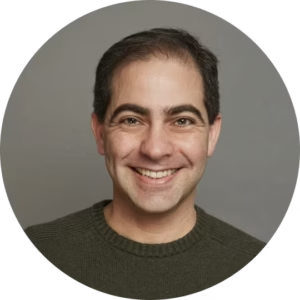 Prof. Michael Levy
Harvard Medical School, Boston, MA, USA
“Satralizumab in MOGAD is certainly one of the most important updates, given that it is the first positive Phase 3 trial in this disease area.
Another major development is fenebrutinib in multiple sclerosis, including both relapsing and primary progressive forms of MS.”
Read Prof. Levy’s full Q&A here: Phase 3 METEOROID trial in MOGAD: Satralizumab cuts relapse risk by 68%
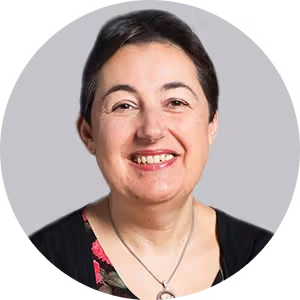 Prof. Jacqueline French
NYU Comprehensive Epilepsy Center, New York, NY, USA
“In the field of epilepsy, my top treatment updates at AAN this year were:
First, azetukalner X-TOLE2, because it delivered a large Phase 3 focal-onset seizure signal in a highly treatment-resistant population and appears positioned for near-term regulatory submission.
Second, RAP-219, a TARPγ8 AMPA receptor negative allosteric modulator. In an open-label Phase 2a focal epilepsy study using RNS long episodes as an objective biomarker, follow-up data showed sustained reductions in long episodes and clinical seizures, with planned Phase 3 trials expected to start in Q2 2026.
Third, there was a great deal of discussion around gene-based therapies targeting monogenic epilepsies that are moving toward the clinic. This represents the dawn of a new era, shifting from antiseizure medicines as symptomatic therapy toward future disease-targeted and disease-modifying therapies. Having said that, there is no doubt that for many people with Epilepsy, antiseizure medicines will still be needed for the foreseeable future.”
Read Prof. French’s full Q&A here: Azetukalner in focal epilepsy: Phase 3 X-TOLE2 results and the future of KV7-targeted therapy
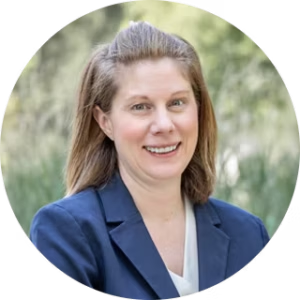 Prof. Amanda L. Piquet
University of Colorado Anschutz, Aurora, CL, USA
“At AAN 2026, one of the most exciting developments was the growing momentum behind CAR T-cell therapy in autoimmune neurologic disease, particularly the KYSA-8 miv-cel data in SPS. It was exciting to see meaningful clinical improvement in such a refractory patient population alongside a favorable safety profile.”
Read Prof. Piquet’s full Q&A here: Phase 2 KYSA-8 trial in stiff-person syndrome: Could CAR T-cell therapy transform autoimmune neurology?
 Dr Matteo Gastaldi
University of Pavia, Italy
“The data from the METEOROID study in the treatment of MOGAD were among the most important updates presented at AAN this year.”
Read Dr Gastaldi’s full Q&A here: Improving access to NMOSD diagnosis: Multicenter evaluation of the iDOT AQP4 assay
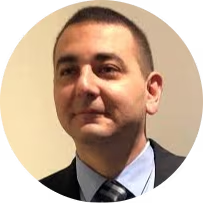 Dr Yair Mina
National Institute of Neurological Disorders and Stroke (NINDS), Bethesda, MD, USA
“AAN 2026 highlighted continued momentum in immune-based therapies across neurologic disease, with a particular emphasis on understanding not just whether treatments work, but how they work.
In neuroinfectious disease and PML specifically, studies reinforced that restoring immune function is necessary but not sufficient. What matters is the quality and specificity of the immune response.
More broadly, these developments reflect a shift toward mechanism-driven and personalized strategies, which I believe will define the next phase of therapeutic progress in PML and other neuroinfectious conditions.”
Read Dr Mina’s full Q&A here: NT-I7 in progressive multifocal leukoencephalopathy: Immune reconstitution and antiviral immunity in a pilot study
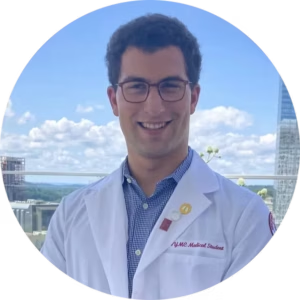 Isaac Thorman
New York Medical College, Valhalla, NY, USA
“With respect to GLP-1 therapies specifically, one of the highlights was the plenary session debating whether GLP-1 therapies are “more hype than hope.” It brought together leading researchers presenting both sides of the argument, and I think discussions like that are incredibly valuable, especially for trainees.
A lot of the broader conversations around GLP-1 therapies reflect exactly what we are seeing in our own work. These drugs are currently one of the hottest topics in medicine. Every journal you open seems to contain another study evaluating GLP-1 therapies in a different disease area.
We were excited to contribute to that discussion by focusing on cognitive impairment and aging, which are obviously very important public health concerns.
One thing we have really tried to emphasize is that our findings should not be interpreted simply as “GLP-1 therapies increase cognitive impairment.” The broader context is this survival paradox. Patients may be living longer because of the cardiovascular and metabolic benefits of these therapies, and that extended survival may statistically increase the likelihood of developing cognitive impairment later in life.”
Read Dr Thorman’s full Q&A here: GLP-1 therapies and cognitive impairment: New data highlights possible “survival paradox”
View specialities list for more content
Cite: Leading neurologists at AAN 2026 reflect on the most important therapeutic breakthroughs. touchNEUROLOGY. 24 March 2026.
Editor: Katey Gabrysch, Editorial Director.
Disclosures: See individual Q&As for full disclosure lists.
The content was developed and edited by human editors. No fees or funding were associated with its publication. touchNEUROLOGY utilize AI as an editorial tool (ChatGPT (GPT-4o) [Large language model]. https://chat.openai.com/chat).
This content has been developed independently by Touch Medical Media for touchNEUROLOGY in collaboration with the speakers. Views expressed are the speaker’s own and do not necessarily reflect the views of Touch Medical Media.
SIGN UP to touchNEUROLOGY!
Join our global community today for access to thousands of peer-reviewed articles, expert insights, and learn-on-the-go education across 150+ specialties, plus concise email updates and newsletters so you never miss out.