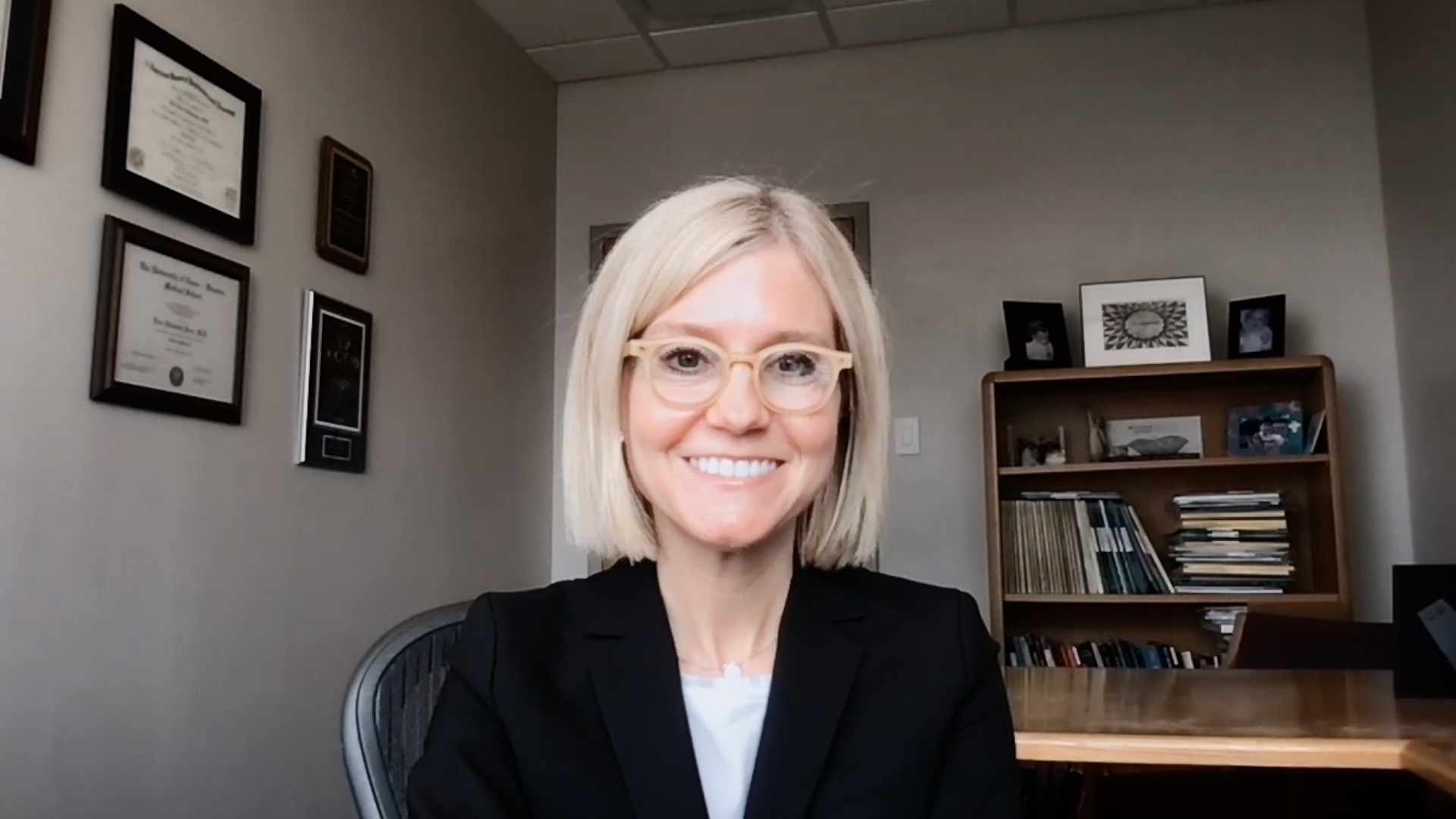
There are currently no disease-modifying medications for the treatment of Huntington’s disease, and current treatment is entirely dependent on symptomatic therapies. Prof. Erin Furr-Stimming (McGovern Medical School, University of Texas, Health Science Centre, Houston, TX, USA) joins touchNEUROLOGY to discuss the current treatment landscape of Huntington’s disease and the limitations of current treatment options.
Watch part 2 of this interview, where Prof. Erin Furr-Stimming discusses the use of valbenazine for chorea associated with Huntington disease.
The abstracted entitled: ‘KINECT HD: Results from a Randomized, Double-Blind, Placebo-Controlled Phase 3 Trial of Valbenazine for Chorea Associated with Huntington Disease (HD)‘ was presented at the American Academy of Neurology (AAN) annual meeting, April 2-7, 2022.
Questions:
- Could you give us a brief overview of the current treatment landscape for Huntington disease (HD)? (0:20)
- What are the limitations of current treatment options? (1:10)
Disclosures: Erin Furr-Stimming receives indirect grant/research support from HSG provided by NBI to UTHealth for her role as principal investigator on the Kinect-HD study, and no direct grant/research support remuneration from UniQure, CHDI, HDSA, Cures within Reach, Prilennia, and Roche/Genetech.
Support: Interview and filming supported by Touch Medical Media. Interview conducted by Katey Gabrysch.