 The International League Against Epilepsy (ILAE) is a leading global organisation devoted to epilepsy research, education, advocacy and care. Founded in 1909, it now comprises more than 120 national chapters worldwide and serves as a premier resource for clinicians, scientists and public-health stakeholders working to improve diagnosis, treatment and prevention of epilepsy.
ILAE’s goals include promoting research and innovation, supporting professional training, advocating for epilepsy as a public-health priority, and ensuring long-term organisational viability to sustain advances in care worldwide.
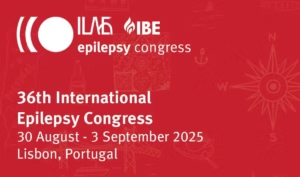
The 36th International Epilepsy Congress (IEC 2025) held in Lisbon, the largest global gathering for the epilepsy community, brought together clinicians, researchers, educators, advocates and industry partners. It showcased cutting-edge science, emerging clinical advances, and reinforced ILAE’s commitment to improving life for people with epilepsy worldwide.
IEC 2025 in numbers & scope
- The congress attracted over 4,400 participants from 120 countries, underlining truly global engagement.
- More than 130 scientific sessions were held, including keynote lectures, teaching courses, platform presentations, and poster sessions, covering the full spectrum of epilepsy research and care.
- The programme ranged from basic science, clinical advances, neurotechnology, patient-centred care, to global public-health and advocacy, reflecting the breadth of ILAE’s mission.
Key scientific & clinical highlights from IEC 2025
Updated seizure classification: A global standard
One major outcome of ILAE’s ongoing work: the release of the 2025 operational classification of epileptic seizures. This update refines prior frameworks to better characterise seizure types, improving diagnostic precision and standardising definitions globally.
This revision promises to impact clinical practice worldwide, helping clinicians classify seizures more accurately and thus tailor management and treatment more appropriately.
Advances in treatment for refractory epilepsy
Among the clinical advances discussed at the congress were new data on treatments for drug-resistant epilepsy. For instance, recent studies on the efficacy and safety of the antiseizure drug cenobamate generated considerable interest, offering hope for patients with refractory epilepsy.
A renewed focus on patient-centered care and global access
IEC 2025 underscored a growing emphasis on care models that integrate patient experience, access inequities, and global health perspectives. Panels such as the “Patient-centred healthcare: from challenge to change” symposium engaged multi-stakeholder perspectives on unmet everyday needs of people with epilepsy.
Furthermore, the global composition of attendees and speakers reinforces ILAE’s commitment to reducing disparities in epilepsy care, particularly in under-resourced settings.
What IEC 2025 means for the future
- Emerging therapies and data presented (e.g. for refractory epilepsy) offer renewed hope for patients who do not respond to current treatments.
- The strong global participation signals that epilepsy research and care remain a collective priorit, with cross-border collaboration, knowledge sharing and advocacy at the core.
- ILAE’s long-term mission: combining research, education, and advocacy, appears firmly on track, with IEC 2025 serving as a milestone that reinvigorates progress for patients, clinicians and researchers alike.
Emerging research from IEC 2025
| Abstract / topic | What to watch |
| Updated seizure classification (2025). New operational classification of epileptic seizures/syndromes from ILAE. | The 2025 update introduces clearer definitions, replaces “awareness” with “consciousness,” refines seizure terminology (e.g., “observable features”), and formally recognizes some previously under-characterised seizure types (e.g. negative myoclonus). This could enhance diagnostic precision worldwide, improve consistency between clinics, and influence research/end-point definitions in trials.1,2 |
| Real-world data on cenobamate in drug-resistant focal epilepsy (post-marketing / large-cohort data). | Several studies presented at IEC 2025 report that cenobamate not only reduces seizure frequency, but may also lower hospitalisations, emergency visits and possibly reduce risk of sudden unexpected death in epilepsy (SUDEP) when sustained seizure freedom is achieved. These findings suggest quality-of-life and long-term outcome benefits beyond seizure control, potentially redefining treatment goals for refractory epilepsy.3,4,5
|
| Large early-access and real-world “high-dose cenobamate” cohort results (e.g. long-term retention, effectiveness across diverse populations). | Data from early-access programmes and wide clinical use cohorts help clarify tolerability, long-term safety and durability of effect outside of tightly controlled trials. If these hold up, cenobamate may become a stronger candidate for earlier use, potentially shifting treatment paradigms for drug-resistant focal epilepsy.6 |
| Emerging use of ASMs and adjunctive therapies across age groups and epilepsy types, including audits of drugs like brivaracetam in mixed adult/paediatric use, and genetic/pharmacogenomic studies (e.g. ABCG2 polymorphism affecting lamotrigine levels). | These studies help refine personalized medicine in epilepsy, considering age, genetics, prior treatment history and comorbidities, which could lead to more nuanced prescribing, better tolerability, and tailored anti-seizure strategies.7-10 |
| Neurostimulation & device innovation for drug-resistant epilepsy. First-in-human optoelectronic vagus-nerve stimulation device was presented, novel focal neurostimulation therapies, and their effects on seizures and networks. | For patients who don’t respond to ASMs, improved neurostimulation technology could offer new hope. These early device-based data may pave the way for innovations in neuro-modulation, seizure control, and network-targeted therapies.11 |
| Focus on patient-centred care, lived experience & global equity: there was a strong inclusion of people with epilepsy and caregivers in sessions, and dedicated symposia on public health, access and psychosocial aspects. | This signals a shift: epilepsy research and care are no longer only about seizures, but also about quality of life, social impact, equity of access, especially important globally. It may influence how future clinical trials and guidelines consider patient-reported outcomes and real-world applicability. |
| Genetics, biomarkers, and stratification for prevention/precision care (including gut microbiome, epilepsy risk factors, and personalised treatment planning) | If validated, this could lead to earlier identification of people at risk, personalised preventive strategies, or targeted interventions, shifting the paradigm from reactive treatment to early detection and prevention.12,13 |
Top 10 abstracts from IEC 2025
| Abstract title | Authors | Abstract no. | Key findings |
|---|---|---|---|
| Cenobamate in Refractory Focal Epilepsy: Real-World Retention and Seizure Outcomes14 | Ruiz-Perella et al. | P-CIFE-001 | High 6-month retention (97.5%) and meaningful seizure reduction in refractory focal epilepsy. |
| Impact of Prior ASM Failure on Cenobamate Effectiveness15 | Bosaka et al. | P-CIFE-014 | Earlier cenobamate use led to higher responder rates and improved seizure outcomes. |
| Healthcare Resource Utilisation Before and After Cenobamate Initiation16 | Angelini Pharma Investigators | P-CIFE-022 | Reductions in emergency visits and hospitalisations; possible benefit for SUDEP risk when seizure freedom achieved. |
| Vormatrigine (PRAX-562) for Treatment-Resistant Epilepsy: RADIANT Study17 | Praxis Medicines | P196 | Early data show rapid seizure reduction and favourable tolerability. |
| Relutrigine (PRAX-628) in Developmental and Epileptic Encephalopathies (DEE)18 | Praxis Medicines | P157 | Strong seizure reduction across DEE cohorts; emerging precision therapy. |
| Emergency Use of Relutrigine in SCN2A-DEE19 | Praxis Medicines | P158 | Case report suggests benefit in refractory infantile status epilepticus using targeted sodium-channel modulation. |
| MicroRNA Signatures in Paediatric Epilepsy20 | Salimbene L, et al. | P-BIOM-031 | Identifies miRNA biomarkers associated with epilepsy severity and subtype. |
| Electrical, Metabolic and Genetic Cascades in Focal Epilepsy21 | Warren AEL, et al. | P-BASIC-119 | Multimodal analysis reveals interlinked molecular and electrophysiological pathways in focal epilepsy. |
| Inhibitory Interneuron Activity at Seizure Onset22 | Nasimbera A, et al. | P-NEURO-044 | Increased inhibitory interneuron firing immediately before ictal onset; insights into seizure initiation mechanisms. |
| Cardiac and Psychiatric Comorbidities in Epilepsy: A Multidisciplinary Analysis23 | O’Brien TJ, et al. | P-COMORB-010 | Demonstrates bidirectional interactions between epilepsy, cardiac instability and psychiatric burden. |
Related content
Emerging advances in Dravet Syndrome: Highlights from IEC 2025
Neurostimulation in the Treatment of Epilepsy: A Review of Current and Emerging Therapies
References:
-
-
International League Against Epilepsy. Updated classification of epileptic seizures (2025). Available at: https://www.ilae.org/updated-classification-epileptic-seizures-2025
-
Fisher RS, et al. Operational classification of seizure types: 2025 update. PubMed. Available at: https://pubmed.ncbi.nlm.nih.gov/40583065/
-
Angelini Pharma. Angelini Pharma presents data demonstrating benefits of cenobamate for adults living with uncontrolled epilepsy. Available at: https://www.angelinipharma.com/news-media/press-releases/angelini-pharma-presents-data-demonstrating-benefits-of-cenobamate-for-adults-living-with-uncontrolled-epilepsy/
-
NeurologyLive. Cenobamate data show seizure reduction, lower healthcare use, potential SUDEP risk reduction. Available at: https://www.neurologylive.com/view/cenobamate-data-shows-seizure-reduction-lower-health-care-use-potential-sudep-risk-reduction
-
Cabezudo-García P, et al. Post-marketing experience with cenobamate in the treatment of focal epilepsies: A multicentre cohort study. Available at: https://www.researchgate.net/publication/389029409_Post-marketing_Experience_with_Cenobamate
-
Dinoi G. Cenobamate treatment for drug-resistant epilepsy: A quality-of-life and drug utilisation study from an Italian pharmacy. Abstract P180. 36th International Epilepsy Congress; 2025.
-
Stavropoulos I. Efficacy and tolerability of brivaracetam: preliminary results of a national multicentre prospective audit in mixed adult and paediatric populations. Abstract P184. 36th International Epilepsy Congress; 2025.
-
Zafeiriou D. Brivaracetam adjunctive therapy in paediatric and adult patients with focal-onset seizures in mid-European countries: 12-month real-world outcomes from the BRIVA-REG study. Abstract P200. 36th International Epilepsy Congress; 2025.
-
Vivash L. Re-analysis of trials of brivaracetam using Epilepsy DOOR to holistically assess benefits and harms of anti-seizure medications. Abstract P211. 36th International Epilepsy Congress; 2025.
-
Šušak Sporiš I. Loss-of-function ABCG2 c.421C>A polymorphism decreases lamotrigine trough concentrations in adults with epilepsy. Abstract P186. 36th International Epilepsy Congress; 2025.
-
First-in-human study for drug-resistant epilepsy: usability and efficacy of a novel optoelectronic vagus nerve stimulation device over a 3-month follow-up. Abstract P1008. 36th International Epilepsy Congress; 2025.
-
De Caro C. Role of gut microbiota as biomarker and drug target in Angelman syndrome. Presented at 36th International Epilepsy Congress; 2025.
-
Prast-Nielsen S. Association between seizure reduction during ketogenic diet treatment and changes in circulatory metabolites and gut microbiota composition. Presented at 36th International Epilepsy Congress; 2025.
-
Ruiz-Perella M, et al. Cenobamate in refractory focal epilepsy: real-world retention and outcomes. Abstract P-CIFE-001. 36th International Epilepsy Congress; 2025.
-
Bosaka N, et al. Impact of treatment history on cenobamate response. Abstract P-CIFE-014. 36th International Epilepsy Congress; 2025.
-
Angelini Pharma. Healthcare utilisation after cenobamate initiation. Abstract P-CIFE-022. 36th International Epilepsy Congress; 2025.
-
Praxis Medicines. Vormatrigine in treatment-resistant epilepsy: RADIANT study. Abstract P196. 36th International Epilepsy Congress; 2025.
-
Praxis Medicines. Relutrigine in developmental and epileptic encephalopathies. Abstract P157. 36th International Epilepsy Congress; 2025.
-
Praxis Medicines. Emergency use of relutrigine in SCN2A-DEE. Abstract P158. 36th International Epilepsy Congress; 2025.
-
Salimbene L, et al. MicroRNA biomarkers in paediatric epilepsy. Abstract P-BIOM-031. 36th International Epilepsy Congress; 2025.
-
Warren AEL, et al. Electrical, metabolic and genetic cascades in focal epilepsy. Abstract P-BASIC-119. 36th International Epilepsy Congress; 2025.
-
Nasimbera A, et al. Inhibitory interneuron activity at the transition to seizure onset. Abstract P-NEURO-044. 36th International Epilepsy Congress; 2025.
-
O’Brien TJ, et al. Comorbidities in epilepsy: cardiac and psychiatric interactions. Abstract P-COMORB-010. 36th International Epilepsy Congress; 2025.
-
This content has been developed independently by Touch Medical Media for touchNEUROLOGY.
Editor: Katey Gabrysch, Editorial Director.
Disclosures: The content was developed and edited by human editors. No fees or funding were associated with its publication. touchNEUROLOGY utilize AI as an editorial tool (ChatGPT (GPT-4o) [Large language model]. https://chat.openai.com/chat).
Cite: Key scientific & clinical highlights from IEC 2025. touchNEUROLOGY. 11 December 2025.
Register now to receive the touchNEUROLOGY newsletter!
Don’t miss out on hearing about our latest peer reviewed articles, expert opinions, conference news, podcasts and more.