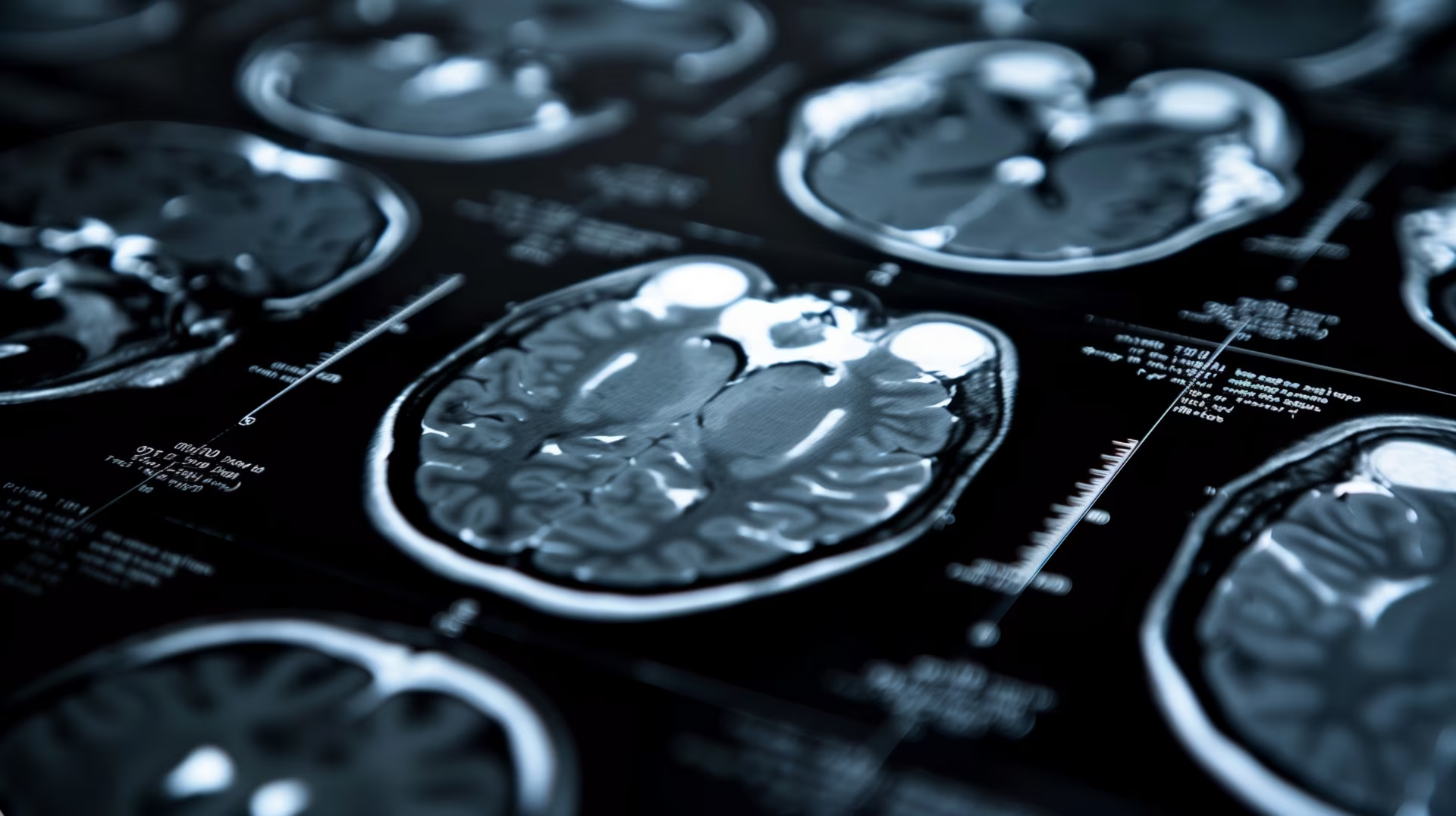

At ECTRIMS 2025, updates to the McDonald diagnostic criteria for multiple sclerosis (MS) highlighted the increasing role of magnetic resonance imaging (MRI), optical coherence tomography (OCT) and body-fluid biomarkers in supporting early and accurate diagnosis.
We spoke with Dr Marcello Moccia about the criteria’s flexible design, global applicability, and how multimodal approaches could improve prognostication and treatment selection.
Dr Marcello Moccia is Associate Professor at the University of Naples Federico II, Italy, and a consultant neurologist. His main expertise is in MS, and his research focuses on clinical studies, MRI, and biomarkers to improve diagnosis and disease monitoring.
The main change in the new version of the MS diagnostic criteria is really the overall philosophy. For the first time, we now have a flexible framework that integrates several diagnostic dimensions rather than relying on one rigid pathway.
We begin with the clinical presentation and then assess the number of anatomical regions showing typical MS lesions. These can be identified using MRI, visual evoked potentials, or OCT of the optic nerve. From there, we can add paraclinical tools, such as cerebrospinal fluid (CSF) or plasma biomarkers to confirm the diagnosis where necessary.
So, while the inclusion of new modalities is important, the key innovation is this multimodal and adaptable approach. It allows earlier, more confident diagnoses across different healthcare settings worldwide, reducing both missed diagnoses and overdiagnoses, each of which can have serious consequences.
This broader framework also supports better prognostication, helping us identify patients at higher risk of relapse or disability progression, and could ultimately influence treatment selection. Altogether, it represents a major advance for people living with MS.
I don’t believe there will be a single way to apply the new criteria; rather, multiple valid routes will emerge depending on local expertise, centres and resources.
Some centres will continue to rely on CSF analysis, which remains perfectly appropriate. Others will integrate advanced MRI sequences. For example, using the central vein sign or paramagnetic rim lesions to strengthen diagnostic certainty. Centres with strong ophthalmic capacity may focus on the optic nerve, applying OCT or visual evoked potentials, while others may adopt blood-based biomarkers as they become validated.
This pluralistic model marks a real shift from previous criteria. In the past, if a single test was unavailable or inconclusive, clinicians often had no alternative. Now, by offering several complementary options, we can make the diagnosis more accurately and much earlier, using the tools best suited to each centre. This flexibility will make implementation more feasible globally and improve equity of access to high-quality MS care.
At ECTRIMS 2025, several presentations addressed one of the biggest remaining challenges in MS: chronic inflammation and the mechanisms that drive long-term disability progression.
We have become very effective at treating acute inflammation, that is, relapses and new inflammatory lesions in the brain and spinal cord, but tackling the chronic component remains more difficult. Encouragingly, new data on Bruton’s tyrosine kinase (BTK) inhibitors suggest that these agents could target both active and smouldering inflammation. These effects were supported not only by MRI outcomes but also by emerging biomarker correlations.
Another highlight was the evidence of potential remyelination effects from a combination of metformin and clemastine, two existing, widely used drugs. This points to the exciting potential of drug repurposing as a complementary strategy alongside novel agents.
Finally, many studies focused on biomarkers of treatment response, both imaging-based and blood-derived, which are essential to accelerate research, shorten clinical trials, and move toward truly personalised MS therapy. It’s a very exciting time for MS research, with genuine opportunities to refine diagnosis, treatment, and long-term management.
Access the recently published McDonald criteria revisions1
This content has been developed independently by Touch Medical Media for touchNEUROLOGY. Views expressed are the speaker’s own and do not necessarily reflect the views of Touch Medical Media.
Editor: Katey Gabrysch, Editorial Director.
Disclosures: This short article was prepared by touchNEUROLOGY in collaboration with Marcello Moccia. The content was developed and edited by human editors. No fees or funding were associated with its publication. touchNEUROLOGY utilize AI as an editorial tool (ChatGPT (GPT-4o) [Large language model]. https://chat.openai.com/chat).
Marcello Moccia has nothing to disclose in relation to this interview.
Cite: Marcello Moccia. Integrating imaging and biomarkers in the revised McDonald criteria. touchNEUROLOGY. 07 October 2025.
Related content
- New McDonald criteria revisions: 6 key updates from National MS Society
- Shaping the future of MS care with Dr Bardia Nourbakhsh
- Recognizing multiple sclerosis early: An interview with Lisa Doggett
References:
-
The Lancet Neurology. Revised 2024 McDonald criteria for the diagnosis of multiple sclerosis. Lancet Neurol. 2025. Available at: https://www.thelancet.com/journals/laneur/article/PIIS1474-4422(25)00270-4/abstract (accessed September 2025).
Register now to receive the touchNEUROLOGY newsletter!
Don’t miss out on hearing about our latest peer reviewed articles, expert opinions, conference news, podcasts and more.