
Parkinson's Disease
An Introduction to Parkinson's Disease
Parkinson’s disease (PD), the most common movement disorder, is characterized by dopamine deficiency and motor symptoms, such as tremor, rigidity, bradykinesia and impaired balance; non-motor symptoms are increasingly being recognized as important too. Despite advances in our understanding of PD by functional genetics, brain imaging and biomarker detection, it remains incurable. While levodopa remains the mainstay of therapy, other treatments include levodopa plus carbidopa (oral/gel infusion), dopamine agonists, MAO-B and COMT inhibitors, anticholinergics and amantadine. Latest approvals include opicapone, a COMT inhibitor, and istradefylline, an adenosine A2A antagonist; both boost the effect of levodopa for better symptom control. Investigational approaches include disease-modifying therapies targeting α-synuclein and its pathways, immunotherapies, stem-cell therapy and non-pharmacological interventions targeting motor symptoms, including gene therapy and adaptive deep-brain stimulation.
Browse video highlights and short articles from the conference hub, providing insights into the latest updates from major conferences and peer-reviewed articles from the journal portfolio. This is complimented by a range of educational activities from our expert faculty, with patient outcomes at the forefront.
Our supporting partners do not constitute an endorsement of the content on this page.



How advances in molecular understanding are shaping Parkinson's disease classification, patient stratification, and the future of personalized care Parkinson’s disease has historically been diagnosed and classified primarily according to clinical features. However, advances in genetics, molecular biomarkers, and our ...

Highlights from the European Academy of Neurology (EAN) 2026 Congress included new phase 3 data in ocular myasthenia gravis, emerging migraine treatments, longer-term results in multiple sclerosis, and advances in deep brain stimulation for Parkinson’s disease. The 12th Congress of the ...
Meet the future leaders transforming neurology The touchNEUROLOGY Future Leaders 2026 programme recognizes outstanding early- and mid-career clinicians, researchers and scientists who are shaping the future of neurology. Nominated by peers across the global neurology community, these innovators are leading advances ...
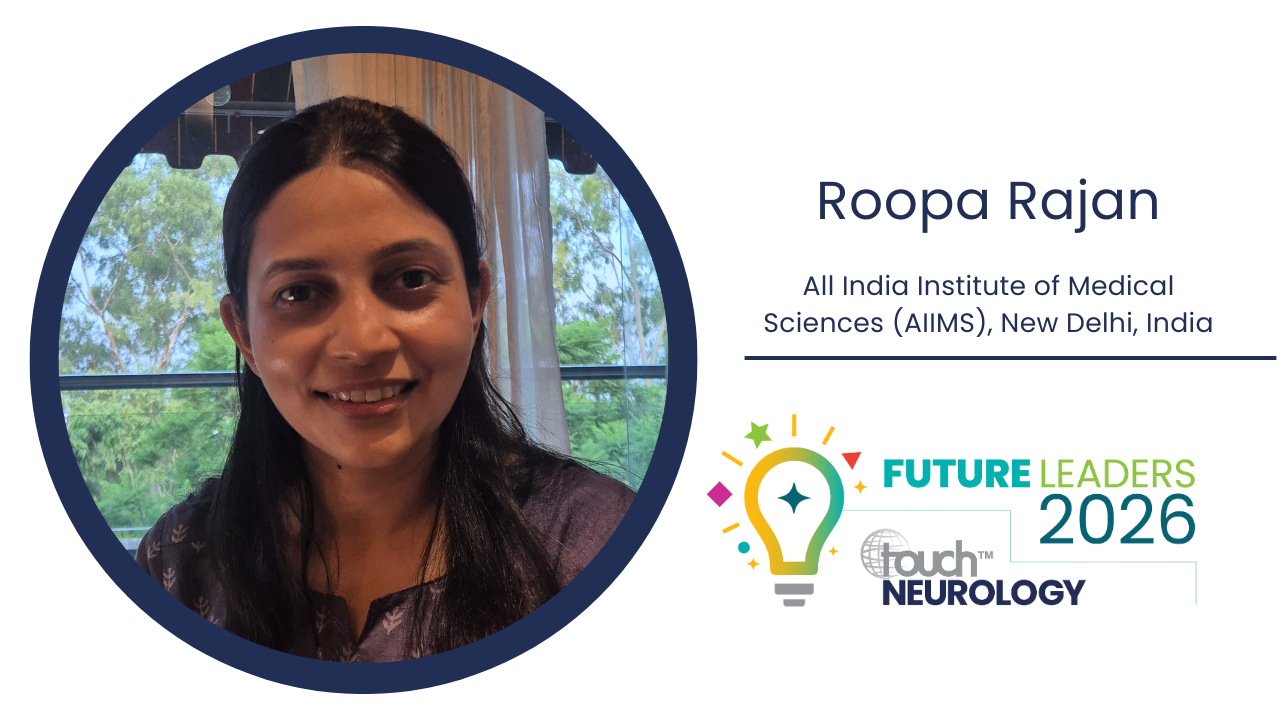
We are delighted to announce Dr Roopa Rajan as a touchNEUROLOGY Future Leader 2026, selected by peers as one of the neurologists changing the future of Parkinson's disease and movement disorders. We spoke with Dr Roopa Rajan (All India Institute of ...

Leading experts share their perspectives on the most important therapeutic and treatment updates at AAN 2026 and discuss how these findings may shape the future of neurologic care At American Academy of Neurology (AAN) Annual Meeting, Chicago, IL, USA, April 18–22, 2026, major ...

Emerging data from AAN 2026 across neuroimmunology, epilepsy, neuromuscular disease, movement disorders and neuroinfectious disease highlighted the continued evolution of neurology toward more precise, personalized and mechanism-driven care. The American Academy of Neurology (AAN) Annual Meeting, Chicago, IL, USA, from April 18–22, 2026, ...

The late-breaking science sessions at AAN Annual Meeting 2026, Chicago, IL, USA brought together a wide range of pivotal and practice-shaping data spanning rare disease, neuroimmunology, headache, epilepsy, neurodegeneration and neuromuscular medicine. Several presentations reported positive phase III findings, while others ...

The Alzheimer’s and Parkinson’s Diseases Conference (AD/PD) 2026, held in Copenhagen, Denmark, brought together over 5,800 delegates to discuss advances across neurodegenerative diseases, including Alzheimer’s disease (AD), Parkinson’s disease (PD), amyotrophic lateral sclerosis (ALS) and related disorders. ...

We often focus on clinical excellence, but spend less time developing broader skills that could help us better lead with purpose and build more fulfilling, impactful careers. In this episode, part of a mini-series in partnership with LEADderm, Dr Jennifer Soung and Denise Mann explore how clinicians can engage with the media to educate, empower and extend their impact beyond the clinic.

Early and accurate diagnosis of Parkinson’s disease (PD), alongside timely patient education and support, can have a significant impact on long-term outcomes. In this Q&A, Rebecca Gilbert, MD, PhD, Chief Mission Officer at the American Parkinson Disease ...

In this year-end review, we are pleased to share personal highlights from members of the touchNEUROLOGY Editorial Board, whose perspectives offer a window into the innovations that have most influenced clinical practice and research over the past 12 months. Their reflections capture not only the momentum of 2025, but also the promise of what lies ahead as the field continues to evolve.
In our inaugural touchNEUROLOGY Future Leaders 2025 campaign, we celebrate the next generation of neurologists, rising stars shaping the future of clinical practice, research, and education across neurological specialties.

Dr Bedia Samanci is a 2025 touchNEUROLOGY Future Leader, and is already making a significant impact in the field of clinical neurology. In this Q&A we discuss advanced neuroimaging, biomarker discovery and the integration of machine learning into neurological diagnostics. Areas that promise to shape the future of patient care.

Prof. Joaquim Ferreira shares insights from EAN 2025 on the future of Parkinson’s disease care. He discusses realistic timelines for DMTs, the evolving role of gene therapy for genetic subgroups, and the potential of adaptive deep brain stimulation. Prof. Ferreira also highlights the growing importance of optimizing current treatments, interdisciplinary care, and addressing persistent challenges such as gait disturbance, dyskinesia, and cognitive decline.

At EAN 2025, Prof. K. Ray Chaudhuri shares insights into cutting-edge Parkinson's drug delivery methods, the future of biomarker-driven care, advances in managing sleep disturbances, and the vital role of lifestyle modifications in optimizing patient outcomes.
Physician burnout is at a critical point. In this episode, Nicky speaks with Dr Alfred Atanda about why so many physicians are burning out and what can be done to change the trend. From personal experience to system-wide solutions, Dr Atanda shares valuable insights on improving physician well-being and building a more effective healthcare culture.
“Your brain thrives on connection; meeting people, interacting and sharing ideas is vital for not only your individual brain health but also our species survival” - Dr Hannah Critchlow Nominated as a touchNEUROLOGY Future Leader 2025, we speak with Dr ...
Log into your Touch Account
Keep track of your clinical interests and newsletter subscriptions.
Sign up with an Email
Or use a .
Register now for FREE access
Already registered? Login below.