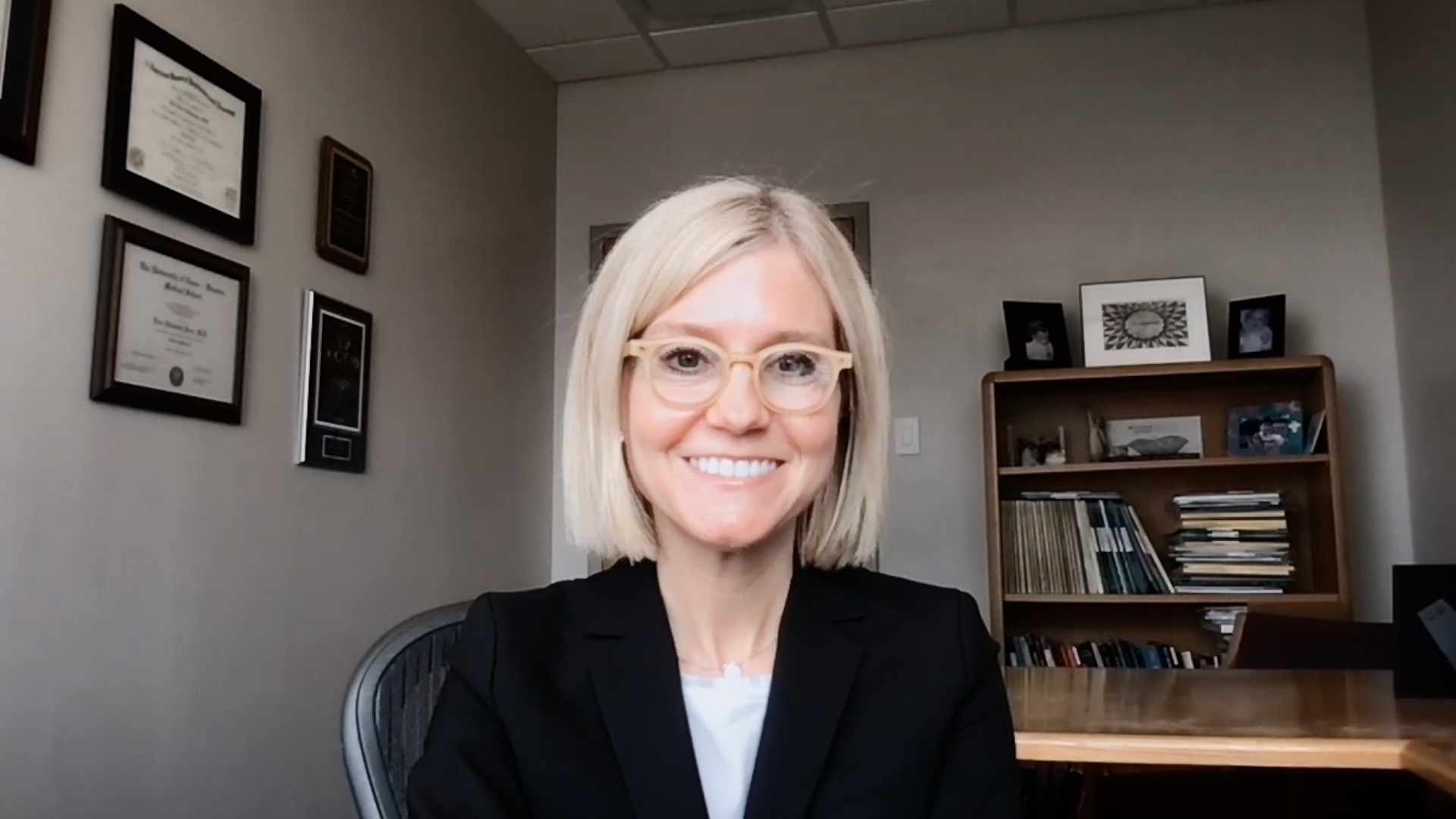
We are delighted to announce Dr Rebecca Casterton as a touchNEUROLOGY Future Leader 2026, selected by peers as one of the neurologists changing the future of neurodegenerative disease.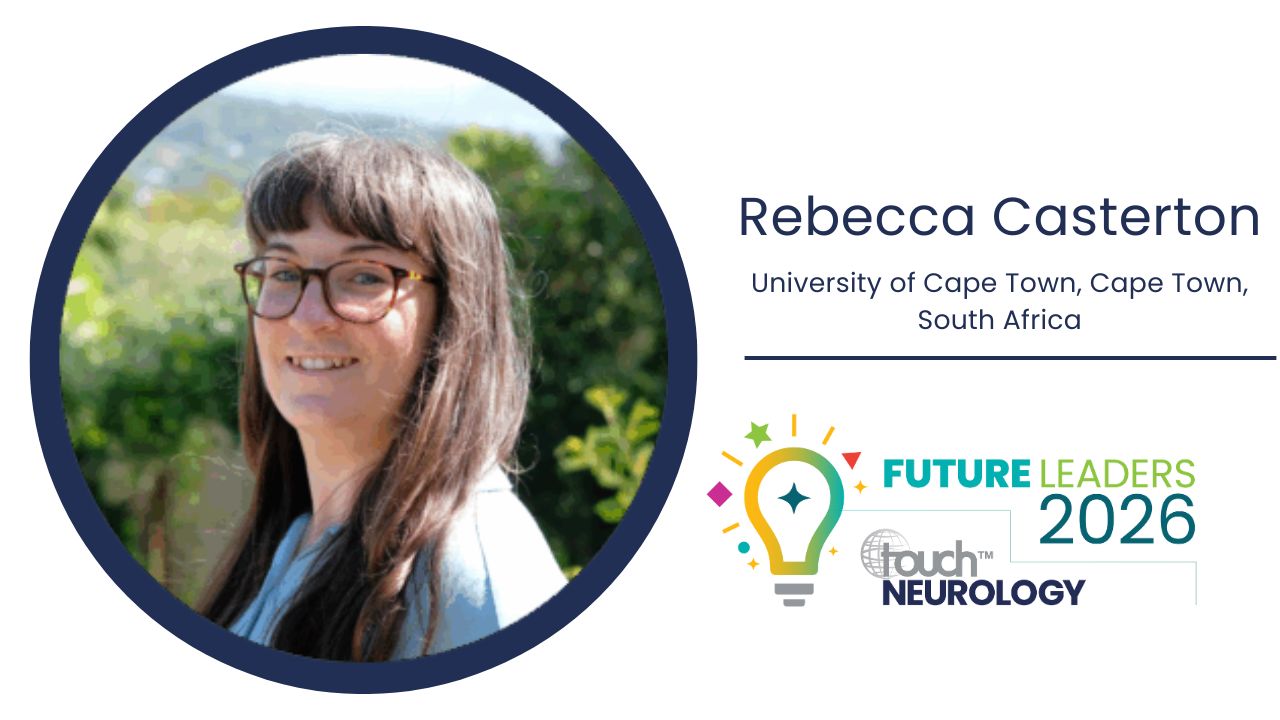
We spoke with Dr Rebecca Casterton (University of Cape Town, Cape Town, South Africa), a Wellcome Trust Early-Career Research Fellow whose work focuses on the cellular mechanisms underlying neurodegenerative diseases. Dr Casterton completed her PhD in Neuroscience at King’s College London, where she helped characterize karyoptosis, a newly identified form of neuronal cell death implicated in conditions including frontotemporal dementia, Alzheimer’s disease and motor neuron disease. Following postdoctoral research at the UK Dementia Research Institute investigating DNA damage and repair in frontotemporal dementia, she joined the University of Cape Town, where she is now establishing her own independent research program.
Her current research explores why mature neurons attempt to re-enter the cell cycle and how this process contributes to neurodegenerative disease. Using human stem cell-derived neuronal models, post-mortem brain tissue and advanced live-cell imaging approaches, her work aims to uncover new therapeutic opportunities for frontotemporal dementia and motor neuron disease.
In this interview, Dr Casterton reflects on what inspired her career in neuroscience, discusses the milestones that have shaped her research journey, and shares why advances in neurodegenerative disease therapeutics are giving the field renewed optimism.
What inspired you to pursue a career in neurology?
I have always been interested in animals, nature and understanding how the world around us works. Growing up, I originally wanted to be a veterinarian.
Towards the end of high school, neuroscience was introduced to me through my biology classes. The engaging way my teachers presented the subject made me appreciate just how much we still do not understand about the brain and sparked my curiosity to explore it further.
“I try not to lose sight of the impact dementia has on patients and their loved ones when I’m working on experiments in the lab.”
More recently, I have watched grandparents live with dementia and witnessed the impact it has not only on them, but also on those around them. This is something I try not to lose sight of when working on experiments in the lab, and it continues to motivate my research into the causes of neurodegenerative diseases.
What has been the most rewarding moment in your journey so far?
I love teaching research students in the lab, and one of the most rewarding aspects of my career has been seeing students grow in confidence. Some join a project having never picked up a pipette before and wondering whether research is really for them. Watching them develop their skills, confidence and eventually generate experimental ideas of their own is incredibly rewarding.
In terms of my own career, 2026 has been a particularly exciting year. After a years-long journey of peer review, revisions and rejections, my PhD work identifying a novel mechanism of neuronal cell death has finally been published. That has certainly been a rewarding milestone.
I have also recently been awarded a Wellcome Trust Early-Career Award to establish my own independent research program at the University of Cape Town, South Africa, over the next five years.
My research will investigate how and why mature neurons attempt to re-enter the cell cycle. For many years, it was believed that neurons permanently exit the cell cycle once they mature. While substantial evidence now suggests this is not the case, it remains unclear why neurons attempt to restart this process.
“It remains unclear why mature neurons attempt to re-enter the cell cycle, and that’s one of the questions my research aims to answer.”
My work will explore the role of cell-cycle re-entry in neurons, how it changes in neurodegenerative diseases such as frontotemporal dementia and motor neuron disease, and whether it could represent a therapeutic target. We will establish laboratory systems that allow us to observe changes in cell-cycle activity in living human neurons in real time, providing unprecedented insight into what is happening at the cellular level.
It is incredibly rewarding to have the potential of these ideas recognized through such a significant award, particularly after several years of grant rejections and continual refinement of the research program. I am excited to begin this new chapter of my career.
Which current innovations or developments in neurology excite you most for the future?
The neurodegenerative disease research community has experienced several milestone moments over the past few years.
For the first time, we are seeing Alzheimer’s disease therapies that target amyloid-beta accumulation demonstrate the ability to slow disease progression in clinical trials. Similarly, early-stage clinical trials of gene therapies, including antisense oligonucleotides, have shown encouraging results in conditions such as Huntington’s disease, where a single inherited genetic mutation drives disease development.
There is still a long way to go before we achieve cures for these conditions. However, advances such as these have given researchers in neurology a tremendous sense of optimism that increasingly effective treatments will be possible with continued scientific progress.
More content in neurodegenerative diseases
Cite: Dr Rebecca Casterton explores neuronal cell cycle re-entry in neurodegenerative disease: touchNEUROLOGY Future Leader 2026. touchNEUROLOGY. 08 July 2026.
Editor: Katey Gabrysch, Editorial Director.
Disclosures: Rebecca Casterton has nothing to disclose.
The content was developed and edited by human editors. No fees or funding were associated with its publication. touchNEUROLOGY utilize AI as an editorial tool (ChatGPT (GPT-4o) [Large language model]. https://chat.openai.com/chat).
This content has been developed independently by Touch Medical Media for touchNEUROLOGY in collaboration with Dr Rebecca Casterton. Views expressed are the speaker’s own and do not necessarily reflect the views of Touch Medical Media.
SIGN UP to touchNEUROLOGY!
Join our global community today for access to thousands of peer-reviewed articles, expert insights, and learn-on-the-go education across 150+ specialties, plus concise email updates and newsletters so you never miss out.