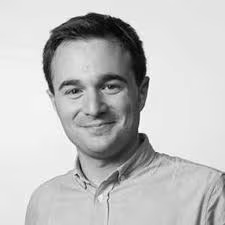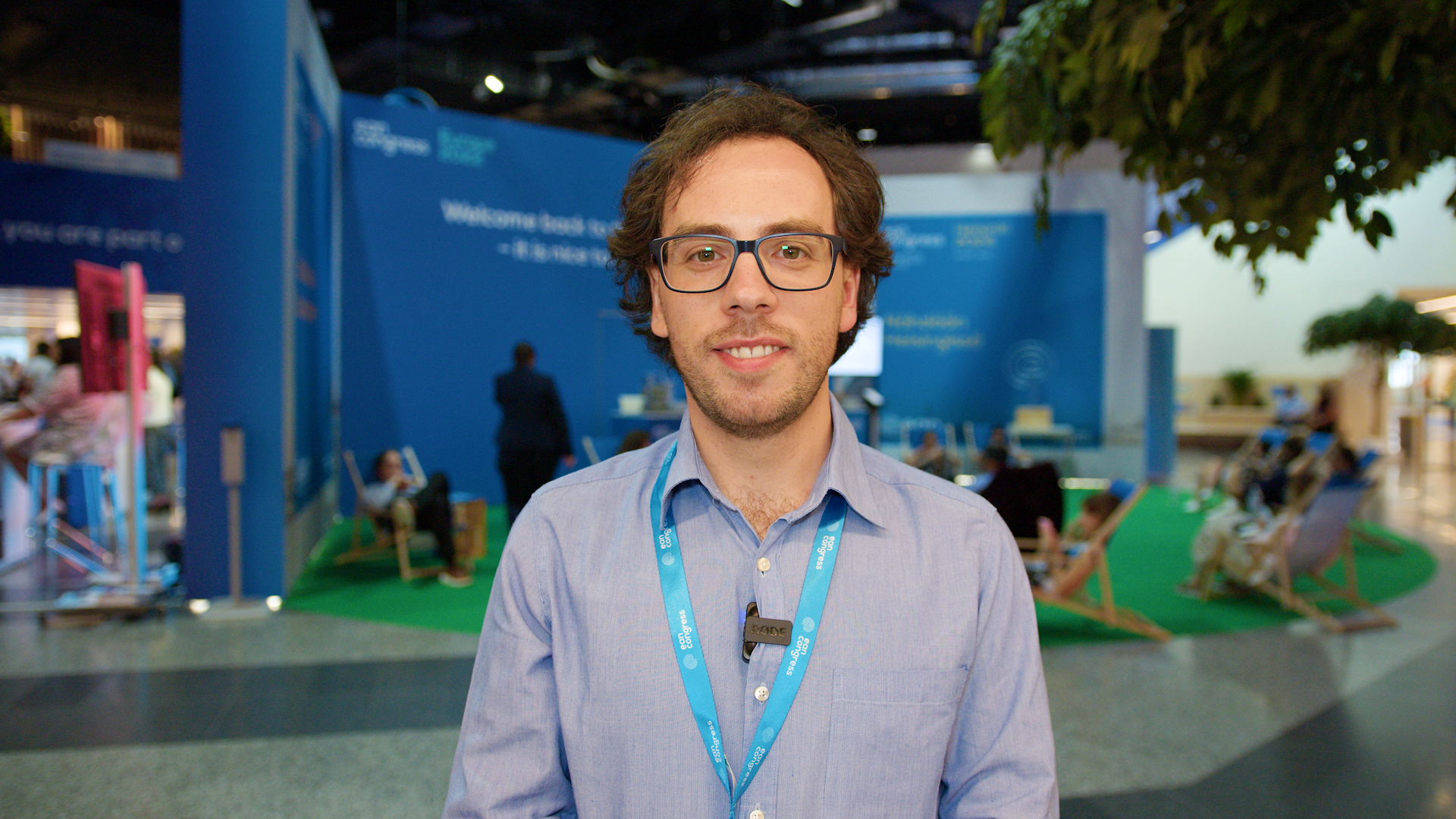
We are delighted to announce Dr Björn Vahsen as a touchNEUROLOGY Future Leader 2026, selected by peers as one of the neurologists changing the future of research in amyotrophic lateral sclerosis and related neurodegenerative diseases
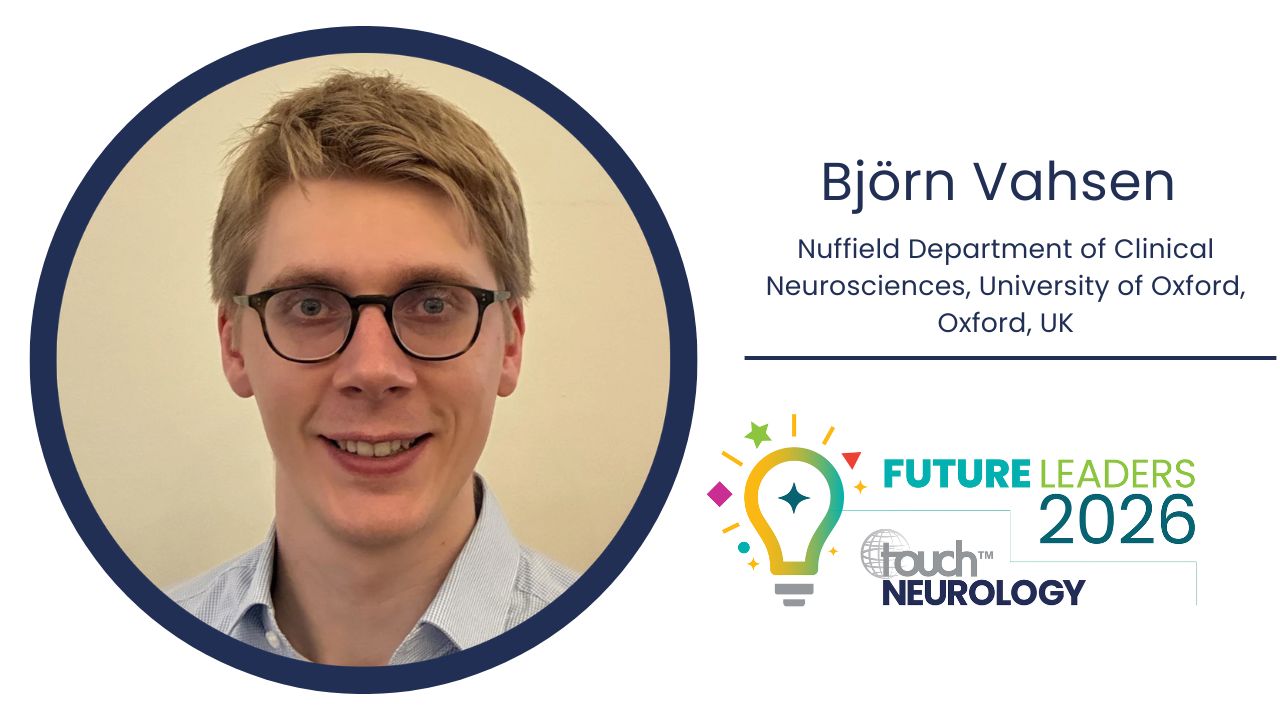 Dr Björn Vahsen (Nuffield Department of Clinical Neurosciences, University of Oxford, Oxford, UK) reflects on his journey into neuroscience, the value of mentorship and the translational advances bringing personalized therapies closer to people living with amyotrophic lateral sclerosis (ALS).
Dr Björn Vahsen is a neuroscientist whose research focuses on uncovering the molecular mechanisms underlying amyotrophic lateral sclerosis (ALS) and related neurodegenerative diseases. His work combines human stem cell models, molecular biology and translational neuroscience to better understand disease mechanisms and identify new therapeutic targets. Having completed his medical training in Germany before undertaking his master’s degree, PhD and postdoctoral research at the University of Oxford, Dr Vahsen is now establishing his own independent research group at the University of Aberdeen, where he will continue to focus his research on stem cell models in ALS.
What inspired you to pursue a career in neurology?
I trained in medicine in Germany, and quite early on I realized that I was fascinated by the brain. That interest began through anatomy and neurophysiology teaching during the first years of medical school.
My interest in neuroscience really developed when I was looking for a laboratory in which to complete my medical doctorate. In Germany, it is common for medical students to undertake a research doctorate alongside their medical degree, often taking time out of clinical training to work in a research laboratory.
I joined a neurodegeneration laboratory led by Prof. Paul Lingor, and it proved to be a fantastic experience. It was an excellent scientific environment, and I thoroughly enjoyed the project as well as the people I worked with. That experience convinced me that I wanted to pursue neuroscience research.
Although I completed medical school and undertook my clinical electives in neurology, I realized that I was more drawn to laboratory-based research than clinical practice. At that stage, I was not entirely sure whether I would leave medicine altogether or continue combining it with research, so I came to Oxford to complete a master’s degree in neuroscience.
One of my master’s projects was based at the Oxford Motor Neuron Disease Centre, working in Prof. Kevin Talbot’s laboratory. From there, everything developed quite naturally. I stayed to complete my PhD, followed by postdoctoral research and, more recently, a research fellowship.
My clinical experience also strengthened my interest in ALS. Looking after patients highlighted how limited our treatment options still are, and that made ALS an incredibly important research challenge for me. I am now about to begin the next stage of my career by establishing my own laboratory at the University of Aberdeen, which is an exciting opportunity.
What has been the most rewarding moment in your journey so far?
One of the most rewarding aspects of research is when you develop a hypothesis, carefully design the experiment and the results reveal exactly what you hoped to discover, or something even more interesting.
Science can be challenging because many experiments simply do not work as expected. Learning to accept that is part of being a researcher. That makes the moments when you discover something genuinely exciting even more rewarding.
Another aspect of my career that I have really enjoyed is mentoring students. I have been fortunate to supervise some outstanding young researchers, and it has been incredibly rewarding to watch them develop their skills and progress to the next stages of their careers. Seeing them succeed at other institutions is something I am very proud of.
“Science can be challenging because many experiments simply do not work as expected. That makes the moments when you discover something genuinely exciting even more rewarding.”
Have there been mentors who have particularly influenced your journey?
Absolutely. Prof. Paul Lingor, who supervised my first research project in Germany, had an enormous influence on my career. As a medical student, I knew very little about laboratory-based research, and he introduced me to the scientific process while providing tremendous encouragement and support. Even now, we remain in close contact. I recently saw him at the European ALS Conference, and it is wonderful that we continue to collaborate and exchange ideas.
Since moving to Oxford, Prof. Kevin Talbot has also been an exceptional mentor. He has supported me not only scientifically, but also in all the broader aspects of building a career in research.
I feel incredibly fortunate to have worked with mentors who have encouraged me throughout my career and helped me develop as an independent scientist.
Which current innovations or developments in neurology excite you most for the future?
One of the most exciting developments is the emergence of personalized, gene-targeted therapies, particularly antisense oligonucleotides.
Recently, we have seen the first encouraging clinical trial results for gene-targeted therapies in ALS, particularly for superoxide dismutase 1 (SOD1)-associated disease. These advances mark an important milestone for the field.
After decades of research identifying the genetic mechanisms underlying ALS, we are now beginning to translate those discoveries into therapies that directly target the biological causes of disease.
There is still a long way to go, but this feels like a genuine turning point. Seeing discoveries move from the laboratory into clinical trials, and ultimately towards improving patient care—is incredibly exciting and gives me great optimism for the future of ALS research.
“After decades of research, we are now beginning to translate our discoveries into therapies that directly target the biological causes of ALS.”
More content in neurodegenerative diseases
Cite: Dr Björn Vahsen explores precision therapies for amyotrophic lateral sclerosis: touchNEUROLOGY Future Leader 2026. touchNEUROLOGY. 08 July 2026.
Editor: Katey Gabrysch, Editorial Director.
Disclosures: Bjorn Vahsen has nothing to disclose.
The content was developed and edited by human editors. No fees or funding were associated with its publication. touchNEUROLOGY utilize AI as an editorial tool (ChatGPT (GPT-4o) [Large language model]. https://chat.openai.com/chat).
This content has been developed independently by Touch Medical Media for touchNEUROLOGY in collaboration with Bjorn Vahsen. Views expressed are the speaker’s own and do not necessarily reflect the views of Touch Medical Media.
SIGN UP to touchNEUROLOGY!
Join our global community today for access to thousands of peer-reviewed articles, expert insights, and learn-on-the-go education across 150+ specialties, plus concise email updates and newsletters so you never miss out.