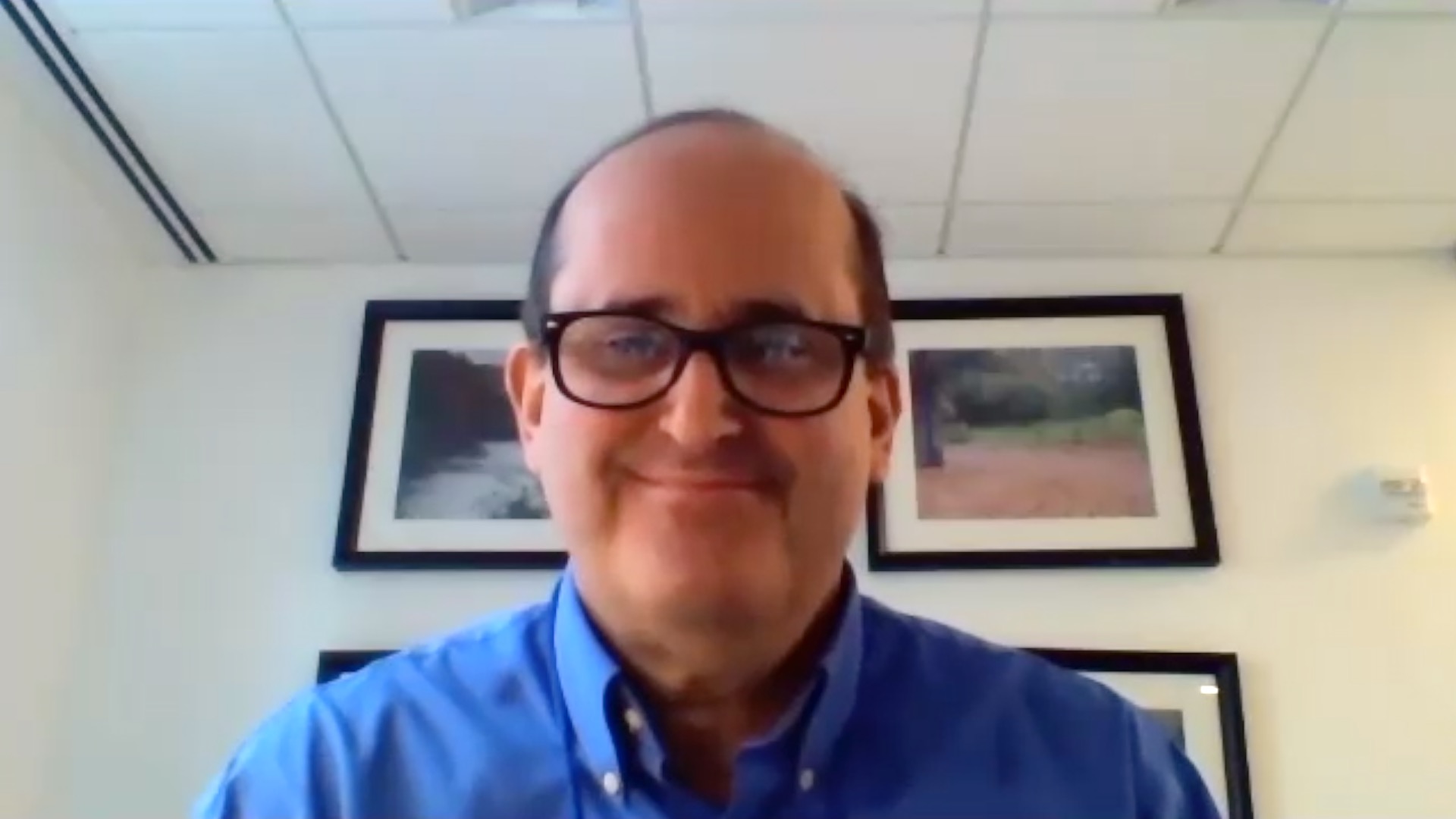
Prof. George Grossberg discusses the unmet need in agitation associated with Alzheimer’s disease, the rationale behind the phase 3 ADAGIO studies, and the evolving role of biomarkers and caregivers in improving patient care.

We spoke with Prof. George Grossberg, Saint Louis University School of Medicine, St. Louis, MO, USA, at the Alzheimer’s Association International Conference (AAIC) 2026 about the need for new approaches to managing agitation in Alzheimer’s disease.
In this interview, he discusses the scientific rationale for the phase 3 ADAGIO programme evaluating xanomeline/trospium (KarXT), the importance of incorporating biomarkers and caregiver perspectives into clinical trials, and the research developments at AAIC that he believes are shaping the future of Alzheimer’s disease diagnosis and treatment.
Abstract: Study Design Of Two Phase 3 Trials Of Xanomeline/trospium (karxt) For Agitation Associated With Alzheimer’S Disease (ADAGIO-1/ADAGIO-2)
touchNEUROLOGY coverage of AAIC 2026
Agitation remains one of the most challenging neuropsychiatric symptoms in Alzheimer’s disease. What are the biggest limitations of current management strategies, and why is there a need for additional treatment options?
Neuropsychiatric symptoms, previously called behavioral and psychological symptoms of dementia (BPSD), are, as everyone knows, quite disabling. Patients with symptoms such as agitation, psychosis, apathy and depression experience more rapid disease progression, are more likely to enter nursing homes earlier, and place enormous stress on caregivers, families and professional care providers.
Until very recently, there was not a single FDA-approved drug for any of these neuropsychiatric symptoms. Everything we used was off-label, and the main treatments were antipsychotic medications. These drugs carry a lot of liabilities and side effects, and frankly, there was not strong efficacy data to support their use.
Now we have two FDA-approved treatments, so things are certainly looking better. However, there is still a need for additional options, particularly treatments that are not classified as antipsychotics but may provide benefits for both psychosis and agitation.
That is what KarXT is all about. It targets muscarinic receptors, specifically M1 and M4. The M1 receptor modulates, among other things, cognition, while the M4 receptor modulates excitability and psychosis. The same compound is already approved in many countries, including the USA, as xanomeline–trospium (Cobenfy®) for schizophrenia, and it is now being studied for agitation and psychosis in Alzheimer’s disease.
It is a unique approach with relatively few side effects and without the traditional antipsychotic adverse effects. We need more treatment options, and that is exactly what these studies are designed to investigate. The efficacy data will not be available for another couple of years.
KarXT has demonstrated activity in schizophrenia and builds on earlier evidence with xanomeline in Alzheimer’s disease. What is the scientific rationale for investigating muscarinic receptor agonism as a treatment approach for agitation in people with Alzheimer’s disease?
KarXT is exciting because it represents a completely different mechanism of action from traditional antipsychotics.
It focuses on muscarinic receptors, specifically the M1 and M4 receptors. The M1 receptor modulates, among other things, cognition, while the M4 receptor modulates excitability and psychosis. The same compound is already approved in many countries, including the USA, as xanomeline–trospium (Cobenfy®) for schizophrenia. It is now being studied for agitation, which is the poster presented here, as well as for psychosis in Alzheimer’s disease.
It is a unique approach with relatively few side effects and without the traditional adverse effects associated with antipsychotics. We need more treatment options, and that is exactly what this programme is designed to evaluate. The efficacy data from these studies will not be available for another couple of years.
Which aspects of the ADAGIO-1 and ADAGIO-2 study trial designs do you believe will be most important in determining whether the treatment has meaningful clinical benefit?
That’s a good question. I would not say the trial design itself is particularly innovative because it is fairly standard, but there are aspects that I think are really important.
These are two large, parallel studies, each enrolling approximately 350 patients. Half receive placebo and half receive active treatment over 14 weeks. One of the studies also includes a long-term open-label extension.
What is particularly important is that biomarker confirmation is built into both studies. Many older studies identified patients clinically, but we know from previous data that up to 40% of clinically diagnosed Alzheimer’s disease may actually be something else unless biomarker confirmation is used. In these studies, participants will have either an amyloid PET scan, cerebrospinal fluid analysis or one of the newly approved blood-based biomarkers.
Another important aspect is the inclusion of caregiver-reported outcomes. Caregiver stress is being measured alongside global clinical evaluations, so the studies are looking not only at the patient but also at the broader impact of treatment.
The primary efficacy endpoint is the Cohen-Mansfield Agitation Inventory, which remains the gold-standard instrument for measuring agitation in clinical trials. It is a very detailed assessment. Nobody uses it routinely in the clinic, but it is the measure required by the FDA.
If these phase 3 trials demonstrate positive efficacy and safety, how do you see KarXT fitting into the future treatment landscape for agitation associated with Alzheimer’s disease, and what impact could this have for patients and their caregivers?
KarXT could fit into the treatment landscape in a couple of ways. We know from studies in schizophrenia that it has antipsychotic effects, and earlier studies suggest it also has calming, anti-agitation effects. In Alzheimer’s disease, one of the common drivers of agitation is psychosis, and the two symptoms frequently coexist. In that sense, one treatment could potentially address both.
We also know from the schizophrenia studies that we do not see many of the metabolic problems associated with traditional antipsychotics. There is no significant weight gain, dyslipidemia or many of the cardiovascular complications we typically worry about. That gives it a relatively clean safety profile, which would make it an attractive option if these findings are confirmed.
For caregivers, the impact could be substantial. I often talk about the four most common and most impactful neuropsychiatric symptoms in Alzheimer’s disease: agitation, psychosis, depression and apathy. Of those, agitation and psychosis tend to have the greatest effect on caregivers.
Many care partners do everything they can to keep their loved one at home, but eventually they become exhausted. Very often, the trigger that leads them to consider memory care or institutional care is the emergence of agitation or psychosis.
If we can better manage these symptoms, patients may be able to remain at home longer. It could reduce caregiver stress, burnout and depression, which would be a significant benefit for families as well as patients.
Your separate AAIC presentation highlights the important role of caregivers in recognizing agitation earlier and supporting treatment decisions. How can clinicians better integrate caregiver observations into routine clinical practice, and why is this especially important as new therapeutic options for agitation emerge?
We presented a poster at this year’s AAIC, that looked at an educational study in which we surveyed a large group of caregivers to understand how they approach their primary healthcare provider. We wanted to know whether they discuss agitation or other neuropsychiatric symptoms, and if not, why.
We found there was a great deal of reluctance. There is still stigma associated with these symptoms. Many caregivers felt their clinician was only interested in memory problems, did not have time to discuss behavioral symptoms, or that there was little that could be done.
We shared these findings with a group of specialists, primary care physicians and dementia experts, some of whom were also family caregivers. Together, we developed practical recommendations for primary care providers on how to better identify agitation in people with Alzheimer’s disease.
One of the simplest recommendations was to ask about behavioral change at every visit. Rather than asking whether someone has “agitation,” which many people may not understand, ask questions such as: “Have you noticed any changes in your loved one’s behavior?” “Have they become more irritable?” or “Do they seem to have a shorter fuse than they used to?”. Using everyday language makes it much easier for caregivers to recognize and describe these symptoms.
If we start asking these questions routinely, we are much more likely to identify agitation early, provide appropriate treatment sooner and, ultimately, help both patients and their care partners by reducing stress, burnout and the need for institutional care.
Looking beyond your own research, what have been the most important advances presented at AAIC 2026?
Here at AAIC, one of the biggest take-home messages has been the continued evolution of blood-based biomarkers for the early diagnosis of Alzheimer’s disease.
We are now moving beyond identifying people with mild cognitive impairment due to Alzheimer’s disease and beginning to identify individuals in the preclinical stages of disease. These are people who have no symptoms but may have a first-degree relative with Alzheimer’s disease and are themselves at increased risk. If blood-based biomarkers allow us to identify those individuals earlier, then treatment could become much more about prevention.
Blood-based biomarkers are also becoming increasingly useful for monitoring treatment response. Rather than relying on expensive amyloid PET scans, we may be able to use a relatively simple blood test to follow how patients respond to treatment over time.
Another important theme has been the growing evidence supporting lifestyle modification. We continue to see data from around the world highlighting the importance of exercise, cognitive activity, social engagement and management of cardiovascular risk factors, hearing loss and other modifiable risks. These interventions remain an important part of comprehensive Alzheimer’s disease care.
Finally, there is growing interest in therapies targeting tau. Amyloid has dominated Alzheimer’s disease research over recent years, but tau is another important target, and a number of companies are now developing tau-directed therapies. We are also planning to participate in one of these studies at Saint Louis University.
For me, though, one of the greatest benefits of AAIC is the opportunity to collaborate. It is a chance for scientists, clinicians and educators from around the world to come together, exchange ideas and develop new collaborations. Those conversations are often just as valuable as the presentations themselves.
Related content
From amyloid biology to Alzheimer’s prevention: The next generation of disease-modifying therapies
More content in Alzheimer’s disease
Cite: George Grossberg. From amyloid biology to Alzheimer’s prevention: The next generation of disease-modifying therapies. touchNEUROLOGY. 13 July 2026.
Abstract: Study Design Of Two Phase 3 Trials Of Xanomeline/trospium (karxt) For Agitation Associated With Alzheimer’S Disease (ADAGIO-1/ADAGIO-2)
Editor: Katey Gabrysch, Editorial Director.
Disclosures: George Grossberg is a consultant for Acadia, Alpha Cognition, Axsome Therapeutics, Biogen, BioXcel, Bristol Myers Squibb, Eisai, Karuna, Lilly, Lundbeck, Maplight Therapeutics, Otsuka, and Takeda; has received grant/research support from NIA, and is a speaker’s bureau participant with Otsuka.
The content was developed and edited by human editors. No fees or funding were associated with its publication. touchNEUROLOGY utilize AI as an editorial tool (ChatGPT (GPT-4o) [Large language model]. https://chat.openai.com/chat).
This content has been developed independently by Touch Medical Media for touchNEUROLOGY in collaboration with Prof. George Grossberg. Views expressed are the speaker’s own and do not necessarily reflect the views of Touch Medical Media.
SIGN UP to touchNEUROLOGY!
Join our global community today for access to thousands of peer-reviewed articles, expert insights, and learn-on-the-go education across 150+ specialties, plus concise email updates and newsletters so you never miss out.