New findings from the TOMATO and METEOROID trials add to growing evidence for interleukin-6 pathway inhibition in relapsing MOGAD, an area in which there is currently no approved treatment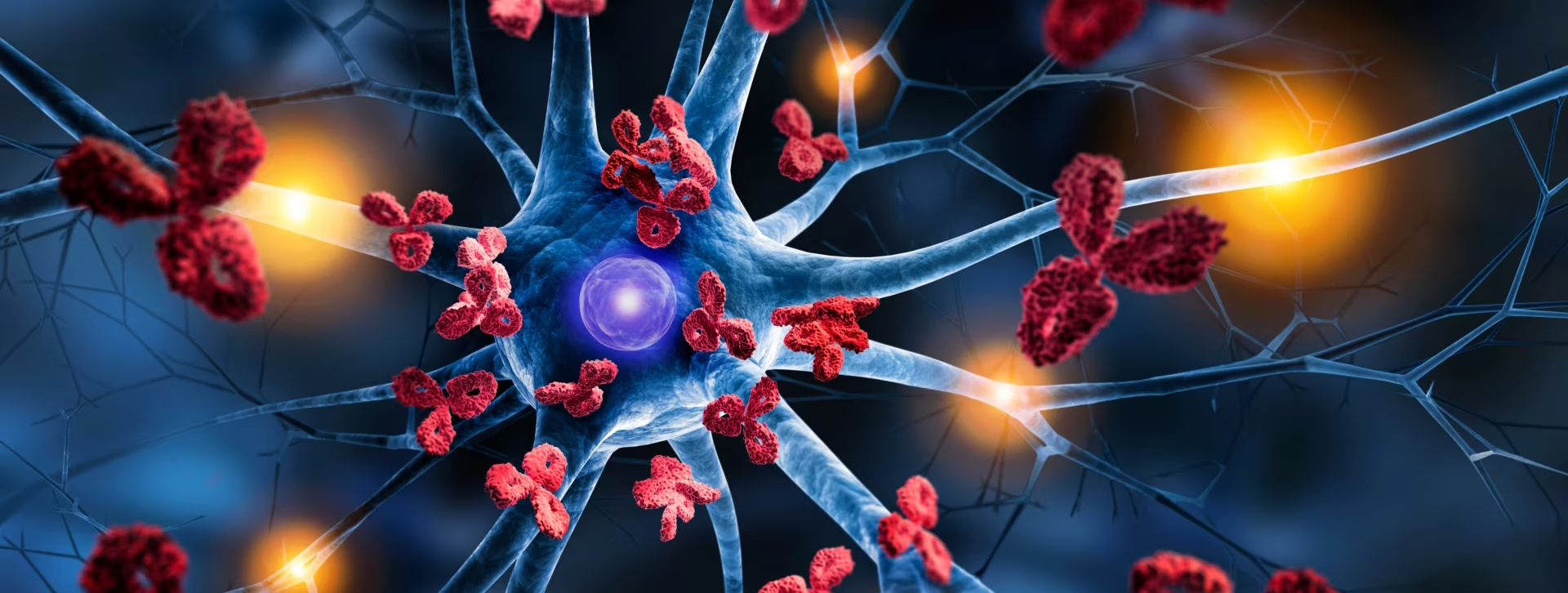
touchNEUROLOGY coverage of MS Toronto 2026
New data presented at MS Toronto 2026 have provided further evidence for targeting the interleukin-6 (IL-6) pathway in myelin oligodendrocyte glycoprotein antibody-associated disease (MOGAD). MOGAD is a rare autoimmune condition in which the immune system attacks myelin in the optic nerves, brain, and spinal cord.1,2
The late-breaking TOMATO trial reported a lower risk of relapse with tocilizumab plus prednisone compared with prednisone alone in people with relapsing MOGAD.3 Separately, new exploratory analyses from the phase 3 METEOROID trial suggested that satralizumab may not only reduce the risk of relapse but could also influence recovery following an attack.4
MOGAD is a rare inflammatory demyelinating disease of the central nervous system that can present with optic neuritis, transverse myelitis, acute disseminated encephalomyelitis, and brainstem or cortical encephalitis.5 Although recovery from individual attacks can be good, recurrent or incompletely recovered attacks can contribute to long-term disability, making relapse prevention an important treatment goal.5
There is currently no approved treatment specifically for MOGAD, and maintenance therapy has largely relied on off-label approaches, including intravenous immunoglobulin, rituximab, mycophenolate mofetil, and other immunosuppressive treatments.5
Tocilizumab reduces relapse risk in the TOMATO trial
The randomized, multicenter, open-label TOMATO trial (NCT06452537) evaluated tocilizumab, an IL-6 receptor inhibitor, in patients aged 12 years or older with relapsing MOGAD.3
Participants were required to have experienced at least one relapse during the previous 12 months or at least two during the previous 24 months. A total of 102 participants were randomized, with 68 receiving intravenous tocilizumab 8 mg/kg every 4 weeks plus a standardized prednisone taper and 34 receiving prednisone alone.3
Relapses occurred in six participants (9%) receiving tocilizumab plus prednisone compared with 18 (53%) receiving prednisone alone, corresponding to a hazard ratio of 0.13 (95% confidence interval [CI] 0.05–0.33; p<0.0001).3
At the end of the study, 81% of participants receiving tocilizumab were both relapse free and steroid free, compared with 26% of those receiving prednisone alone. Tocilizumab was also associated with a lower annualized relapse rate, lower prednisone use, and fewer active magnetic resonance imaging lesions.3
Expanded Disability Status Scale worsening occurred in three participants (4%) receiving tocilizumab plus prednisone and six (18%) receiving prednisone alone. The overall incidence of treatment-emergent adverse events was comparable between the groups, and no deaths occurred.3
The findings provide prospective randomized evidence supporting IL-6 receptor inhibition in relapsing MOGAD. Previous retrospective data have also suggested that tocilizumab may reduce relapse rates, although these studies have been limited by small patient numbers and non-randomized designs.6
METEOROID: Beyond relapse prevention
Satralizumab has also shown efficacy through inhibition of the IL-6 receptor in relapsing MOGAD.
The phase 3 METEOROID trial (NCT05271409) randomized 132 adults and adolescents aged 12 years or older with relapsing MOGAD to satralizumab or placebo, with or without background immunosuppressive therapy.7
Primary findings presented at the 2026 American Academy of Neurology Annual Meeting showed that satralizumab reduced the risk of a new MOGAD relapse by 68% compared with placebo (hazard ratio 0.32; 95% CI 0.15–0.70; p=0.0025).5 At 48 weeks, 87.3% of participants receiving satralizumab were relapse free compared with 66.5% receiving placebo.
Satralizumab also reduced the annualized relapse rate by 66.3%, the annualized rate of active magnetic resonance imaging lesions by 78.5%, and the proportion of participants requiring rescue therapy by 72.5%. Rates of adverse events and infections were comparable between the treatment groups, with no new safety signal identified.7
Speaking to touchNEUROLOGY following the primary METEOROID presentation, Prof. Michael Levy (Massachusetts General Hospital and Harvard Medical School, Boston, MA, USA) described the trial as an important step forward for a disease that currently has no approved therapies.8
“There is therefore a clear need for evidence-based, targeted therapies developed specifically for this disease.”8
Prof. Levy also highlighted the significance of METEOROID within the evolving treatment landscape:
“Satralizumab provides an effective, safe and tolerable approach to preventing relapses in MOGAD.”8
At MS Toronto 2026, investigators presented an exploratory analysis looking more closely at what happened when patients did experience a relapse.4
During the double-blind period, nine of 68 participants (13.2%) receiving satralizumab and 24 of 64 (37.5%) receiving placebo experienced an adjudicated relapse.4
Although worsening at the time of relapse was numerically greater among those receiving satralizumab, recovery over the following 12 weeks was also greater. Median change in Expanded Disability Status Scale score from relapse to the 12-week assessment was −2.0 with satralizumab compared with −0.5 with placebo.4
Across the overall study period, median change in Expanded Disability Status Scale score from Baseline to the end of double-blind treatment or first adjudicated relapse was 0 with satralizumab compared with 0.5 with placebo. Residual visual disability 12 weeks after relapse was reported in one of nine participants (11.1%) receiving satralizumab and four of 24 (16.7%) receiving placebo.4
These analyses were exploratory and involved a relatively small number of participants who experienced a relapse, meaning the findings should be interpreted cautiously. However, they raise the possibility that the effect of satralizumab could extend beyond reducing relapse frequency to influencing outcomes following an attack.
Growing evidence for interleukin-6 inhibition in MOGAD
Taken together, TOMATO and METEOROID add to a growing body of evidence supporting the IL-6 pathway as a therapeutic target in relapsing MOGAD.
The trials differ substantially in their design and cannot be compared directly. METEOROID was a double-blind, placebo-controlled phase 3 trial, whereas TOMATO was open label and compared tocilizumab plus a prednisone taper with prednisone alone.
However, both studies reported substantial reductions in relapse risk with IL-6 receptor inhibition across separate study populations and treatment approaches.
This is particularly relevant in MOGAD because long-term disability appears to be driven largely by the consequences of individual attacks rather than a progressive disease phase. A recent review highlighted the accumulation of incompletely recovered attacks as a key contributor to long-term disability, reinforcing the importance of effective relapse prevention.5
The MS Toronto findings also add a further question: whether future treatments should be assessed not only according to their ability to prevent attacks, but also according to the severity of attacks that occur and patients’ subsequent recovery.
What comes next?
Important questions remain around when maintenance treatment should be started, particularly after a first MOGAD attack; how long treatment should continue; and how emerging therapies compare with established off-label approaches such as intravenous immunoglobulin and rituximab.
Other targeted treatments are also progressing through clinical development, including the phase 3 cosMOG trial (NCT05063162) evaluating rozanolixizumab in adults with MOGAD.9
Satralizumab is currently under regulatory review in the USA for MOGAD, with an FDA decision expected in January 2027.10 If approved, it could become the first therapy specifically authorized for MOGAD.
Related content
Improving access to NMOSD diagnosis: Multicenter evaluation of the iDOT AQP4 assay
Updates in pediatric acute disseminated encephalomyelitis and MOGAD: A Review
Inebilizumab for Neuromyelitis Optica Spectrum Disorders: A Review
References
- Mayo Clinic. Myelin oligodendrocyte glycoprotein antibody-associated disease (MOGAD). Available at: https://www.mayoclinic.org/diseases-conditions/mogad/symptoms-causes/syc-20560476 accessed 20 November 2026.
- Contenetti EC, Boldrini V, Casallas-Vanegas A et al. Future treatments for myelin oligodendrocyte glycoprotein antibody-associated disease: the clinical trial landscape.2025 Dec;30(4):283-297. DOI: 10.1080/14728214.2025.2565189.
- Shen Y, Lian X, Jia Z, et al. Efficacy and safety of tocilizumab in patients with relapsing myelin oligodendrocyte glycoprotein antibody-associated disease (TOMATO): A randomised, multicentre, open-label, phase 3 trial. Presented at: MS Toronto 2026, 10th Joint ACTRIMS-ECTRIMS Meeting, Toronto, Canada, October 23, 2026. Abstr O134.
- Marignier R, Levy M, Flanagan E, et al. Severity and recovery of relapses in patients with relapsing MOGAD treated with satralizumab: Results from the phase 3 METEOROID study. Presented at: MS Toronto 2026, 10th Joint ACTRIMS-ECTRIMS Meeting, Toronto, Canada, October 22, 2026. Abstr O035.
- Mahler JV, Vilardo M, Silva GD, et al. Treatment of myelin oligodendrocyte glycoprotein antibody-associated disease (MOGAD): Acute attacks, relapse prevention, and symptomatic care. Front Neurol. 2026;17:1965135. DOI: doi.org/10.3389/fneur.2026.1965135
- Capecchi F, Graure M, Yasaroglu S, et al. Long-term treatment with interleukin-6 receptor inhibitor tocilizumab in myelin oligodendrocyte glycoprotein antibody-associated disease. Neurology. 2026;2:e000049. DOI: doi.org/10.1212/WN9.000000000000004.
- Levy M, Flanagan E, Kümpfel T, et al. Safety and efficacy of satralizumab in patients with relapsing myelin oligodendrocyte glycoprotein antibody-associated disease (MOGAD): Results from the phase 3 METEOROID trial. Neurology. 2026;106(11 Suppl 1):6020.
- touchNEUROLOGY. Phase 3 METEOROID trial in MOGAD: Satralizumab cuts relapse risk by 68%. 2026. Available at: https://touchneurology.com/insight/phase-3-meteoroid-trial-in-mogad-satralizumab-cuts-relapse-risk-by-68/ (accessed November 19, 2026).
- ClinicalTrials.gov. A study to evaluate the efficacy and safety of rozanolixizumab in adult participants with myelin oligodendrocyte glycoprotein antibody-associated disease. ClinicalTrials.gov Identifier: NCT05063162. Available at: https://clinicaltrials.gov/study/NCT05063162 (accessed November 19, 2026).
- Roche. Roche presents new pivotal trial data across broad neuroimmunology portfolio at MSToronto2026. October 21, 2026. Available at: https://www.roche.com/media/releases/med-cor-2026-10-21 (accessed November 19, 2026).
Editor: Katey Gabrysch, Editorial Director.
Disclosures: The content was developed and edited by human editors. No fees or funding were associated with its publication. touchNEUROLOGY utilize AI as an editorial tool (ChatGPT (GPT-4o) [Large language model]. https://chat.openai.com/chat).
This content has been developed independently by Touch Medical Media for touchNEUROLOGY. It is not affiliated with MS Toronto 2026, ECTRIMS or ACTRIMS. Views expressed are the speaker’s own and do not necessarily reflect the views of Touch Medical Media.
SIGN UP to touchNEUROLOGY!
Join our global community today for access to thousands of peer-reviewed articles, expert insights, and learn-on-the-go education across 150+ specialties, plus concise email updates and newsletters so you never miss out.